Type
Monoclonal Antibody
Applications
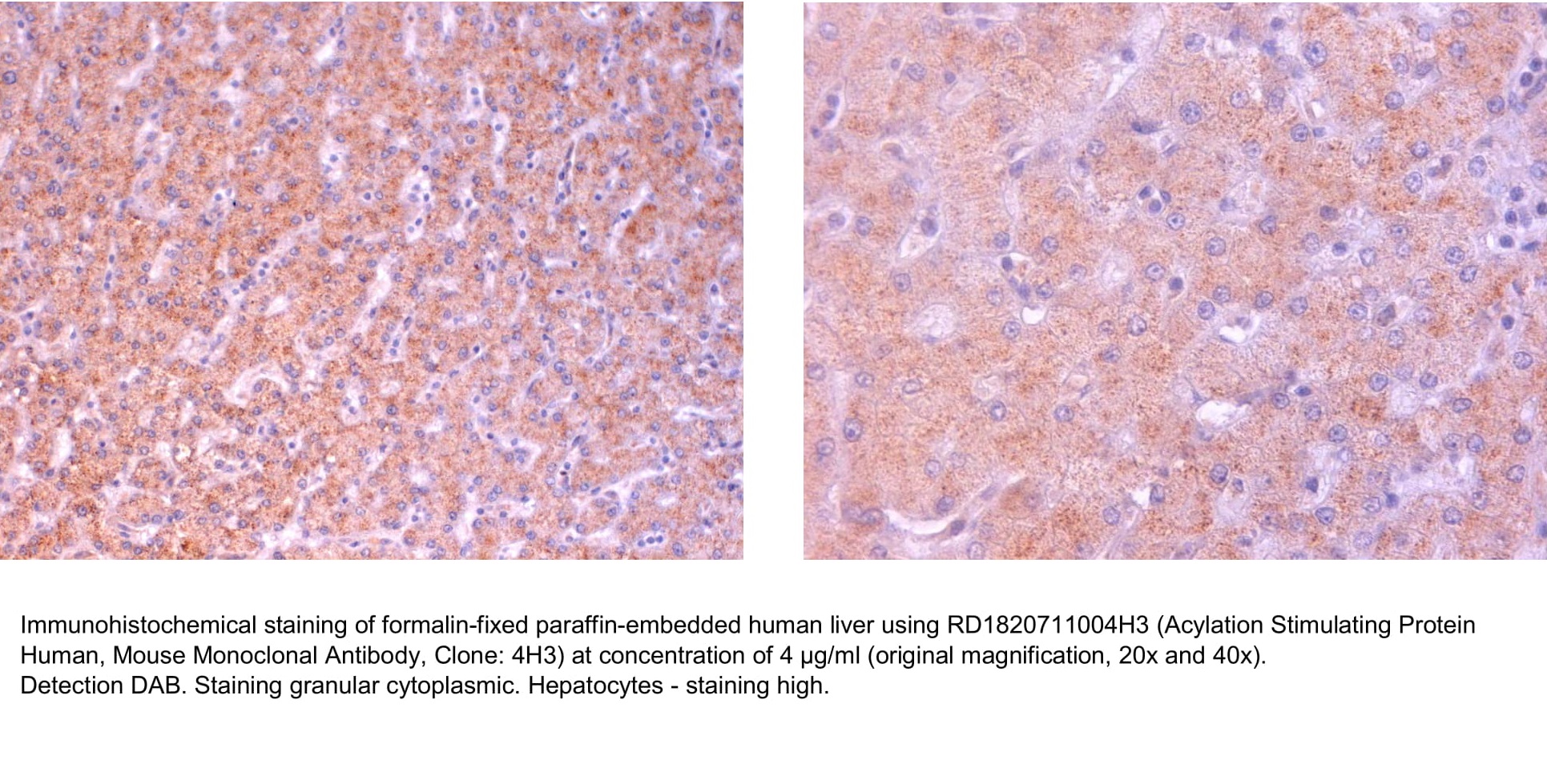
Western blotting, ELISA, Immunohistochemistry
Antibodies Applications
Source of Antigen
Peptide
Hosts
Mouse
Isotype
IgG1
Clone
4H3
Preparation
The antibody is a mouse monoclonal antibody against human peptide.
Amino Acid Sequence
The human peptide with amino acid sequence RASHLGLA (which is located in C-terminal part of the human ASP).
Species Reactivity
Human. Not yet tested in other species.
Purification Method
Affinity chromatography on a column with immobilized protein G.
Antibody Content
0.1 mg (determined by BCA method, BSA was used as a standard)
Formulation
The antibody is lyophilized in 0.05 M phosphate buffer, 0.1 M NaCl, pH 7.2.
Reconstitution
Add 0.2 ml of deionized water and let the lyophilized pellet dissolve completely. Slight turbidity may occur after reconstitution, which does not affect activity of the antibody. In this case clarify the solution by centrifugation.
Shipping
At ambient temperature. Upon receipt, store the product at the temperature recommended below.
Storage/Expiration
The lyophilized antibody remains stable and fully active until the expiry date when stored at -20°C.Aliquot the product after reconstitution to avoid repeated freezing/thawing cycles and store frozen at -80°C. Reconstituted antibody can be stored at 4°C for a limited period of time; it does not show decline in activity after one week at 4°C.
Quality Control Test
SDS PAGE - to determine purity of the antibody
BCA - to determine quantity of the antibody
Note
This product is for research use only.
Research topic
Energy metabolism and body weight regulation
Summary
Acylation Stimulating Protein (ASP, also known as C3a desArg) is one of activation fragments formed from the activation of complement cascade. ASP is produced through a process involving three proteins: C3, factor B and adipsin, which are secreted by adipocytes. Interactions of C3 with factor B and with adipsin result in production of C3a followed by desargination of the carboxyl terminus to generate ASP (C3a desArg). Human ASP contains 77 amino acids with 6 cysteins involved in disulfide bridges between residues 22–49, 23–56 and 36–57. ASP is a highly cationic molecule containing no carbohydrate. ASP has a primary role in regulation of lipid metabolism in adipocytes, where it stimulates glucose uptake, increase the activity of diacylglycerol acyltransferase, and inhibits hormone-sensitive lipase activity. In cellular studies, ASP increases fat storage through increased triglyceride synthesis and decreased intracellular lipolysis. In animal models, ASP deficient mice demonstrate reduced body weight, reduced leptin and reduced adipose tissue mass and ASP deficiency results in protection against development of obesity. In human, a number of studies have shown the relationship between ASP, obesity, diabetes and dyslipidemia. It was reported that concentration of circulating ASP is positively related to body adiposity and decreases after weight loss. Because ASP enhances triglyceride storage, whereas interfering with ASP production reduces body fat and protects against diet-induced obesity and insulin resistance, reducing the production of ASP and ASP receptor antagonists represents potential approaches for treating obesity and type 2 diabetes.