Agouti-Related Protein (AGRP) Human,
Rabbit Polyclonal Antibody
| Other names: AGRP | Product of BioVendor | ||||
| Product: | Size: | ||||
|---|---|---|---|---|---|
| RD181030050 | 0.05 mg | ||||
| Files: Datasheet PDFMSDS | |||||
Product details
Research topic
Energy metabolism and body weight regulation
Introduction to the Molecule
Agouti-related protein is an endogenous antagonist of hypothalamic alpha-melanocortin receptors MC3R and MC4R with potent orexigenic activity. Although a complete deletion of the AGRP gene does not produce any significant metabolic phenotypes, reduction in AGRP expression by RNA interference is associated with increased metabolic rate along with reduced weight gain.
In hypothalamus, it is produced by neurons in the medial portion of arcuate nucleus, which produce also the potent orexigenic peptide Neuropeptide Y (NP-Y). Another site of central AGRP production is the hypothalamic nucleus.
AGRP encompasses 132 amino acid residues and its alpha-melanocortin inhibiting activity results in a 34 amino acid cystine knot domain within the C-terminal (87–132) portion of the protein.
Both AGRP and NP-Y expression was shown to be supressed by leptin. Central administration of AGRP induces hyperphagia and increased gain in body weight in rodents, but may also exert metabolic effects even when hyperphagia is prevented. In the absence of hyperphagia, intracerebralventricular administration of AGRP caused significant increases in plasma leptin and insulin concentrations (two-fold and 1.5-fold, respectively) and fat pad mass.
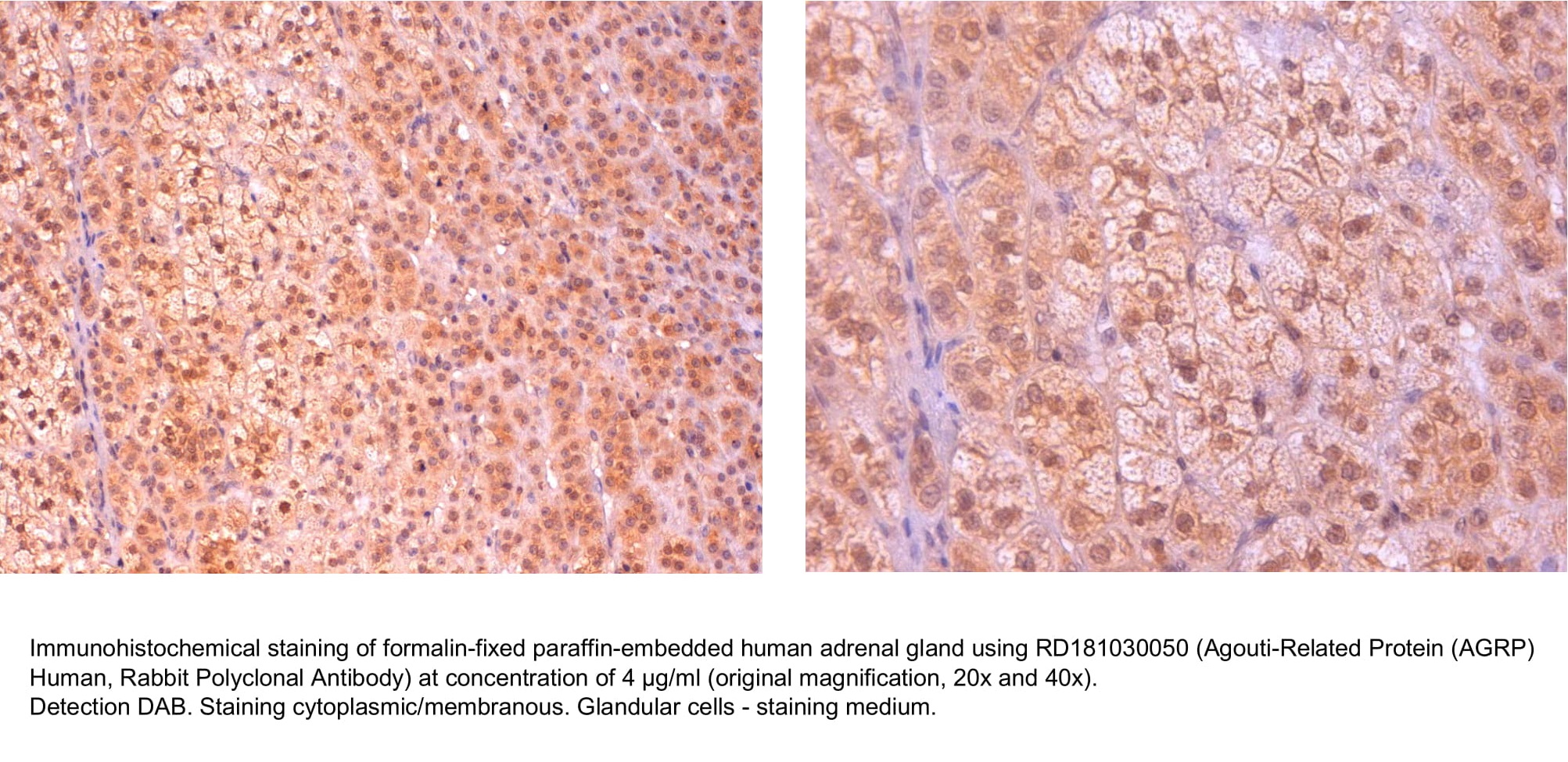
In the perifery, AGRP mRNA was found in adrenal glands, lung, testis, ovary, skeletal muscle and adipose tissue in humans or rodents. In the adrenals, it was shown that AGRP antagonizes glucosteroid production mediated by MC4R. AGRP could then modulate locally the functions of some peripheral tissues such as adrenals.
In human and rat serum, detectable levels of AGRP-like activity were reported in the lower picogram range. The serum AGRP levels were elevated in obese humans compared to lean controls and increased with fasting in rats.
Note
This product is for research use only.
Source of Antigen
E. coli
Host
Rabbit
Preparation
The antibody was raised in rabbits by immunization with the recombinant Human Agouti-Related Protein.
Amino Acid Sequence
The immunization antigen (14.4 kDa) is a protein containing 128 AA of recombinant Human Agouti-Related Protein. N-Terminal His-tag, 16 extra AA (highlighted).
MKHHHHHHHM LVPRGSAQMG LAPMEGIRRP DQALLPELPG LGLRAPLKKT TAEQAEEDLL QEAQALAEVL DLQDREPRSS RRCVRLHESC LGQQVPCCDP CATCYCRFFN AFCYCRKLGT AMNPCSRT
Species Reactivity
Human
Not yet tested in other species.
Purification Method
Immunoaffinity chromatography on a column with immobilized recombinant Human Agouti-Related Protein.
Antibody Content
0.05 mg (determined by BCA method, BSA was used as a standard)
Formulation
The antibody is lyophilized in 0.05 M phosphate buffer, 0.1 M NaCl, pH 7.2. AZIDE FREE.
Reconstitution
Add 0.05 ml of deionized water and let the lyophilized pellet dissolve completely. Slight turbidity may occur after reconstitution, which does not affect activity of the antibody. In this case clarify the solution by centrifugation.
Storage/Stability
The lyophilized antibody remains stable and fully active until the expiry date when stored at –20°C. Aliquot the product after reconstitution to avoid repeated freezing/thawing cycles and store frozen at –80°C. Reconstituted antibody can be stored at 4°C for a limited period of time; it does not show decline in activity after one week at 4°C.
Quality Control Test
Indirect ELISA – to determine titer of the antibody
SDS PAGE – to determine purity of the antibody
Applications
ELISA, Immunohistochemistry, Western blotting
References
- Dinulescu DM, Cone RD. Agouti and agouti-related protein: analogies and contrasts.
- Olszewski PK, Wickwire K, Wirth MM, Levine AS, Giraudo SQ. Agouti-related protein: appetite or reward?.
- Korner J, Wissig S, Kim A, Conwell IM, Wardlaw SL. Effects of agouti-related protein on metabolism and hypothalamic neuropeptide gene expression.
- Shen CP, Wu KK, Shearman LP, Camacho R, Tota MR, Fong TM, Van der Ploeg LH. Plasma agouti-related protein level: a possible correlation with fasted and fed states in humans and rats.
- Argyropoulos G, Rankinen T, Bai F, Rice T, Province MA, Leon AS, Skinner JS, Wilmore JH, Rao DC, Bouchard C. The agouti-related protein and body fatness in humans.
Shopping cart
Your cart is empty.