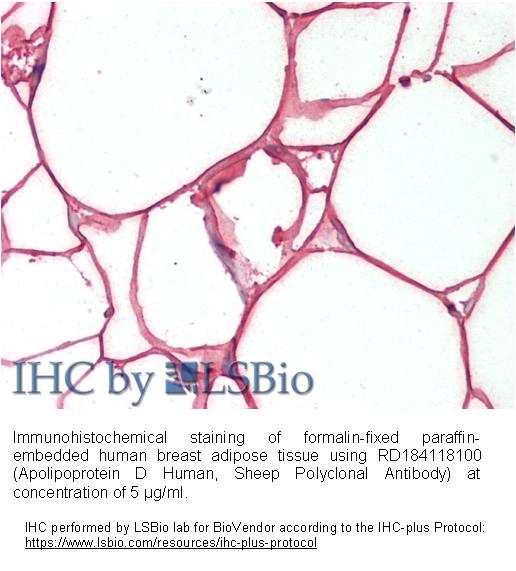
Apolipoprotein D Human,
Sheep Polyclonal Antibody
| Other names: Apo-D | Product of BioVendor | ||||
| Product: | Size: | ||||
|---|---|---|---|---|---|
| RD184118100 | 0.1 mg | ||||
Files:
Datasheet PDFMSDS
|
|||||
Product details
Research topic
Energy metabolism and body weight regulation, Lipoprotein metabolism
Introduction to the Molecule
Human ApoD is a glycoprotein of 169 amino acids, which was discovered in
plasma as an atypical lipoprotein. There, ApoD is peripherally associated with
HDL via disulfide bond with ApoA-II , which itself forms an amphipathic
a-helical belt that wraps around the lipid disc .
ApoD was also isolated as a progesteronebinding protein abundant in mammary
gross cystic disease fluid and it was found as a monomeric protein in apocrine
secretion, where it seems to bind odorants. ApoD mRNA is expressed in a variety
of organs as well as in certain human cancers. Indeed, ApoD has received
attention as prognostic marker for various, often steroid-responsive tumors,
including prostate cancer , breast carcinoma, and cutaneous malignant melanoma.
In addition, ApoD is synthesized by astrocytes in the central nervous systém
and there it seems to be involved in arachidonic acid transport, metabolism, and
signaling. Notably, ApoD plays a well documented pathophysiological role in
several psychiatric disorders , especially in schizophrenia.
Note
This product is for research use only.
References to summary
- Do Carmo S, Fournier D, Mounier C, Rassart E. Human apolipoprotein D overexpression in transgenic mice induces insulin resistance and alters lipid metabolism. Am J Physiol Endocrinol Metab. 2009 Apr;296 (4):E802-11
- Eichinger A, Nasreen A, Kim HJ, Skerra A. Structural insight into the dual ligand specificity and mode of high density lipoprotein association of apolipoprotein D. J Biol Chem. 2007 Oct 19;282 (42):31068-75
- Henry Dong H, Perdomo G. Apolipoprotein D in lipid metabolism and its functional implication in atherosclerosis and aging. Aging (Albany NY). 2009 Jan;1 (1):17-27
- Milne R, Terrisse L, Sirois J, Guinard O, Do Carmo S, Bedirian A, Rassart E. Apolipoprotein D. Biochim Biophys Acta. 2000 Oct 18;1482 (1-2):185-98
- Rassart E, Lafond J, Masse A, Giguere Y, Forest JC, Do Carmo S. Modulation of Apolipoprotein D levels in human pregnancy and association with gestational weight gain. Reprod Biol Endocrinol. 2009;7:92
Source of Antigen
E. coli
Host
Sheep
Preparation
The antibody was raised in sheep by immunization with the recombinant Human Apolipoprotein D.
Amino Acid Sequence
The immunization antigen (19.82 kDa – calculated) is a protein containing 174 AA of recombinant Human Apolipoprotein D.
C-terminal His-tag, 7 extra AA (highlighted).
The amino acid sequence of this product corresponds to the UniProtKB/Swiss-Prot entry P05090 (Human ApoD). Following modifications were made: Four amino acid exchanges were introduced at the surface of ApoD (Trp99His, Cys116Ser, Ile118Ser, Leu120Ser) to enhance the solubility of the recombinant protein and another three (Leu23Pro, Pro133Val, Asn134Ala) to facilitate its genetic manipulation (highlighted).
FHLGKCPNPP VQENFDVNKY PGRWYEIEKI PTTFENGRCI QANYSLMENG KIKVLNQELR ADGTVNQIEG EATPVNLTEP AKLEVKFSWF MPSAPYHILA TDYENYALVY SCTSISQSFH VDFAWILARN VALPPETVDS LKNILTSNNI DVKKMTVTDQ VNCPKLSAHH HHHH
Species Reactivity
Human
Not yet tested in other species.
Purification Method
Immunoaffinity chromatography on a column with immobilized recombinant Human Apolipoprotein D.
Antibody Content
0.1 mg (determined by BCA method, BSA was used as a standard)
Formulation
The antibody is lyophilized in 0.05 M phosphate buffer, 0.1 M NaCl, pH 7.2. AZIDE FREE.
Reconstitution
Add 0.1 ml of deionized water and let the lyophilized pellet dissolve completely. Slight turbidity may occur after reconstitution, which does not affect activity of the antibody. In this case clarify the solution by centrifugation.
Storage/Stability
The lyophilized antibody remains stable and fully active until the expiry date when stored at –20°C.Aliquot the product after reconstitution to avoid repeated freezing/thawing cycles and store frozen at –80°C. Reconstituted antibody can be stored at 4°C for a limited period of time; it does not show decline in activity after one week at 4°C.
Quality Control Test
Indirect ELISA – to determine titer of the antibody
SDS PAGE – to determine purity of the antibody
Applications
ELISA, Western blotting
References
- Do Carmo S, Fournier D, Mounier C, Rassart E. Human apolipoprotein D overexpression in transgenic mice induces insulin resistance and alters lipid metabolism. Am J Physiol Endocrinol Metab. 2009 Apr;296 (4):E802-11
- Eichinger A, Nasreen A, Kim HJ, Skerra A. Structural insight into the dual ligand specificity and mode of high density lipoprotein association of apolipoprotein D. J Biol Chem. 2007 Oct 19;282 (42):31068-75
- Henry Dong H, Perdomo G. Apolipoprotein D in lipid metabolism and its functional implication in atherosclerosis and aging. Aging (Albany NY). 2009 Jan;1 (1):17-27
- Milne R, Terrisse L, Sirois J, Guinard O, Do Carmo S, Bedirian A, Rassart E. Apolipoprotein D. Biochim Biophys Acta. 2000 Oct 18;1482 (1-2):185-98
- Rassart E, Lafond J, Masse A, Giguere Y, Forest JC, Do Carmo S. Modulation of Apolipoprotein D levels in human pregnancy and association with gestational weight gain. Reprod Biol Endocrinol. 2009;7:92
By research topic:
By molecule:
Shopping cart
Your cart is empty.