You are here: Products\Immunoassays\Adipocyte FABP Human ELISA:

Adipocyte FABP Human ELISA

Other names: AFABP, FABP4 Product of BioVendor
Product: Size:
RD191036200R (regulatory status: RUO) 96 wells (1 kit)
Files: Datasheet PDF (RUO)MSDS (RUO)

Product details


Summary

Adipocyte fatty acid binding protein AFABP is a 15 kDa member of the intracellular fatty acid binding protein (FABP) family, which is known for the ability to bind fatty acids and related compounds (bile acids or retinoids) in an internal cavity. AFABP is expressed in a differentiation-dependent fashion in adipocytes and is a critical gene in the regulation of the biological function of these cells . In mice, targeted mutations in AFABP provide significant protection from hyperinsulinemia and insulin resistance in the context of both dietary and genetic obesity. Adipocytes obtained from AFABP-deficient mice also have reduced efficiency of lipolysis in vitro and in vivo, and these mice exhibited moderately improved systemic dyslipidemia. Recent studies also demonstrated AFABP expression in macrophages upon differentiation and activation. In these cells, AFABP modulates inflammatory responses and cholesterol ester accumulation, and total or macrophage-specific AFABP deficiency confers dramatic protection against atherosclerosis in the apoE-/- mice. These results indicate a central role for AFABP in the development of major components of the metabolic syndrome through its distinct actions in adipocytes and macrophages.

Features

  • The total assay time is less than four hours.
  • The kit measures total serum or plasma AFABP.
  • Quality Controls are human serum based. No animal sera are used.

Patent Application Number: DE 10 2005 034 788.6

Research topic

Energy metabolism and body weight regulation

Find out more on biovendor.com


Assay format

Sandwich ELISA, Biotin-labelled antibody

Applications

Cell culture medium, Plasma-Citrate, Plasma-EDTA, Plasma-Heparin, Serum, Tissue extract

Sample requirements

10 µl/well

Storage/Shipping

Store the kit at 2–8°C. Under these conditions, the kit is stable until the expiration date (see label on the box).

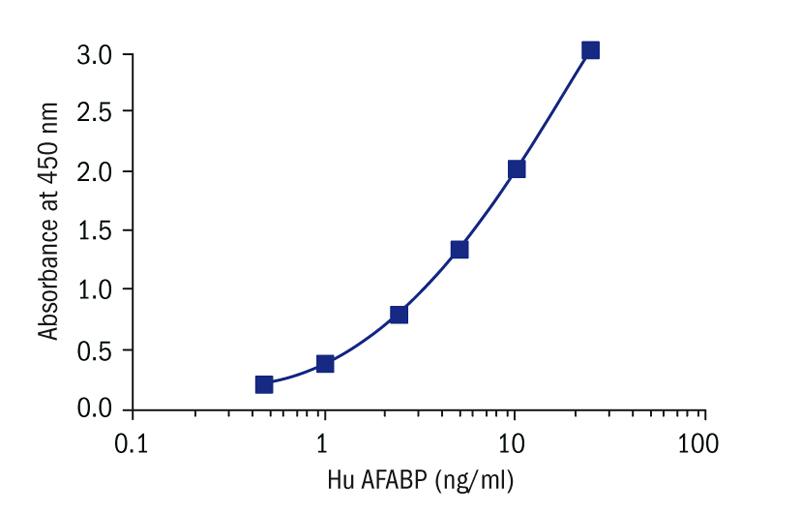
Calibration Curve

Calibration range

0.5 to 25 ng/ml

Limit of detection

Analytical Limit of Detection is calculated from the real human AFABP values in wells and is 0.1 ng/ml.

Intra-assay (Within-Run, n=8)

CV = 5.3 %

Inter-assay (Run-to-Run, n=3)

CV = 3.9 %

Spiking Recovery

105.6 %

Dilution Linearity

107.1 %

Cross-Reactivity

Cat, Dog, Monkey


References to this product

  • . .
  • . .
  • . .
  • Engl J, Ciardi C, Tatarczyk T, Kaser S, Laimer M, Laimer E, Weiss H, Aigner F, Molnar C, Tilg H, Patsch JR, Ebenbichler CF. A-FABP--a biomarker associated with the metabolic syndrome and/or an indicator of weight change?. Obesity (Silver Spring). 2008 Aug;16 (8):1838-42
  • von Eynatten M, Schneider JG, Allolio B . Adipocyte fatty acid binding protein (A-FABP) ist ein neuer Serum-Marker für Adipositas, Insulinresistenz und Metabolisches Syndrom. Diabetologie . 1:S23-S172 (2006)
  • Engl J, Tschoner A, Willis M, Schuster I, Kaser S, Laimer M, Biebl W, Patsch JR, Mangweth B, Ebenbichler CF. Adipocyte fatty acid binding protein during refeeding of female patients with anorexia nervosa. Eur J Nutr. 2009 Oct;48 (7):403-8
  • Stejskal D, Karpisek M . Adipocyte fatty acid binding protein in a Caucasian population: a new marker of metabolic syndrome?. Eur J Clin Invest . Sep;36(9):621-5 (2006)
  • Milner KL, van der Poorten D, Xu A, Bugianesi E, Kench JG, Lam KS, Chisholm DJ, George J. Adipocyte fatty acid binding protein levels relate to inflammation and fibrosis in nonalcoholic fatty liver disease. Hepatology. 2009 Jun;49 (6):1926-34
  • Simon I, Escote X, Vilarrasa N, Gomez J, Fernandez-Real JM, Megia A, Gutierrez C, Gallart L, Masdevall C, Vendrell J. Adipocyte fatty acid-binding protein as a determinant of insulin sensitivity in morbid-obese women. Obesity (Silver Spring). 2009 Jun;17 (6):1124-8
  • Hancke K, Grubeck D, Hauser N, Kreienberg R, Weiss JM. Adipocyte fatty acid-binding protein as a novel prognostic factor in obese breast cancer patients. Breast Cancer Res Treat. 2010 Jan;119 (2):367-7
  • Reinehr T, Stoffel-Wagner B, Roth CL. Adipocyte fatty acid-binding protein in obese children before and after weight loss. Metabolism. 2007 Dec;56 (12):1735-41
  • Xu A, Wang Y, Xu JY, Stejskal D, Tam S, Zhang J, Wat NM, Wong WK, Lam KS . Adipocyte fatty acid-binding protein is a plasma biomarker closely associated with obesity and metabolic syndrome. Clin Chem . Mar;52(3):405-13 (2006)
  • Mohlig M, Weickert MO, Ghadamgadai E, Machlitt A, Pfuller B, Arafat AM, Pfeiffer AF, Schofl C. Adipocyte fatty acid-binding protein is associated with markers of obesity, but is an unlikely link between obesity, insulin resistance, and hyperandrogenism in polycystic ovary syndrome women. Eur J Endocrinol. 2007 Aug;157 (2):195-200
  • Lamounier-Zepter V, Look C, Alvarez J, Christ T, Ravens U, Schunck WH, Ehrhart-Bornstein M, Bornstein SR, Morano I. Adipocyte fatty acid-binding protein suppresses cardiomyocyte contraction: a new link between obesity and heart disease. Circ Res. 2009 Aug 14;105 (4):326-34
  • Bronsky J, Karpisek M, Bronska E, Pechova M, Jancikova B, Kotolova H, Stejskal D, Prusa R, Nevoral J . Adiponectin, adipocyte fatty acid binding protein, and epidermal fatty acid binding protein: proteins newly identified in human breast milk. Clin Chem . Sep;52(9):1763-70 (2006)
  • Shangguan X, Liu F, Wang H, He J, Dong M. Alterations in serum adipocyte fatty acid binding protein and retinol binding protein-4 in normal pregnancy and preeclampsia. Clin Chim Acta. 2009 Sep;407 (1-2):58-61
  • Yun KE, Kim SM, Choi KM, Park HS. Association between adipocyte fatty acid-binding protein levels and childhood obesity in Korean children. Metabolism. 2009 Jun;58 (6):798-802
  • Lui MM, Lam JC, Mak HK, Xu A, Ooi C, Lam DC, Mak JC, Khong PL, Ip MS. C-reactive protein is associated with obstructive sleep apnea independent of visceral obesity. Chest. 2009 Apr;135 (4):950-6
  • Xu A, Tso AW, Cheung BM, Wang Y, Wat NM, Fong CH, Yeung DC, Janus ED, Sham PC, Lam KS . Circulating adipocyte-fatty acid binding protein levels predict the development of the metabolic syndrome: a 5-year prospective study. Circulation . Mar 27;115(12):1537-43 (2007)
  • von Eynatten M, Luzzi VI, Allolio B, Semenkovich CF, Schneider JG . Circulating Adipocyte-Specific Fatty Acid Binding Protein Levels Are Elevated in Type 2 Diabetes and Coronary Artery Disease.
  • Yeung DC, Xu A, Tso AW, Chow WS, Wat NM, Fong CH, Tam S, Sham PC, Lam KS. Circulating levels of adipocyte and epidermal fatty acid-binding proteins in relation to nephropathy staging and macrovascular complications in type 2 diabetic patients. Diabetes Care. 2009 Jan;32 (1):132-4
  • Ciardi C, Tatarczyk T, Tschoner A, Kranebitter M, Niederwanger A, Ebenbichler CF, Patsch JR, Pedrini MT. Effect of postprandial lipemia on plasma concentrations of A-FABP, RBP-4 and visfatin. Nutr Metab Cardiovasc Dis. 2009 Aug 20;
  • Yeung DC, Wang Y, Xu A, Cheung SC, Wat NM, Fong DY, Fong CH, Chau MT, Sham PC, Lam KS. Epidermal fatty-acid-binding protein: a new circulating biomarker associated with cardio-metabolic risk factors and carotid atherosclerosis. Eur Heart J. 2008 Jul 4;
  • Hsu BG, Chen YC, Lee RP, Lee CC, Lee CJ, Wang JH. Fasting serum level of Fatty-Acid-binding protein 4 positively correlates with metabolic syndrome in patients with coronary artery disease. Circ J. 2010 Feb;74 (2):327-31
  • Cabre A, Lazaro I, Girona J, Manzanares JM, Marimon F, Plana N, Heras M, Masana L . Fatty acid binding protein 4 is increased in metabolic syndrome and with thiazolidinedione treatment in diabetic patients. Atherosclerosis . Nov;195(1):e150-e158 (2007)
  • Ben Yahia R, Lichnovska R, Gwozdiewiczova S, Kuzmina G, Chlup R, Luza J, Karpisek M, Brychta T, Petrek J . Fatty Acid Binding Proteins (FABPS) in relation to significant metabolic syndrome markers in diabetic patients and non-diabetic persons - pilot study. Int J Obesity . 29: S1-S19
  • Bol VV, Delattre AI, Reusens B, Raes M, Remacle C. Forced catch-up growth after fetal protein restriction alters the adipose tissue gene expression program leading to obesity in adult mice. Am J Physiol Regul Integr Comp. 2009 Aug;297 (2):R291-9
  • Ben Yahia R, Lichnovska R, Janusova L, Kuzmina G, Karpisek M, Kollar P, Petrek J . Healthy persons versus patients with diabetes mellitus type 2--choosen parameters in serum and subcutaneous abdominal adipose tissue. Vnitr Lek. Jan;53(1):9, 11-7 (2007)
  • Nagaev I, Bokarewa M, Tarkowski A, Smith U. Human resistin is a systemic immune-derived proinflammatory cytokine targeting both leukocytes and adipocytes. PLoS One. 2006;1:e31
  • Haider DG, Schindler K, Bohdjalian A, Prager G, Luger A, Wolzt M, Ludvik B . Plasma adipocyte and epidermal fatty acid binding protein is reduced after weight loss in obesity. Diabetes Obes Metab . Mar 13 (2007)
  • Cabre A, Lazaro I, Girona J, Manzanares JM, Marimon F, Plana N, Heras M, Masana L. Plasma fatty acid binding protein 4 is associated with atherogenic dyslipidemia in diabetes. J Lipid Res. 2008 Aug;49 (8):1746-51
  • Cabre A, Lazaro I, Girona J, Manzanares JM, Marimon F, Plana N, Heras M, Masana L . Plasma fatty acid-binding protein 4 increases with renal dysfunction in type 2 diabetic patients without microalbuminuria. Clin Chem . Jan;54(1):181-7 (2008)
  • Fain JN, Tagele BM, Cheema P, Madan AK, Tichansky DS. Release of 12 Adipokines by Adipose Tissue, Nonfat Cells, and Fat Cells From Obese Women. Obesity (Silver Spring). 2009 Oct 15;
  • Gul O, Calay E, Sezerman U, Basaga H, Gurbuz Y . Sandwich-type, antibody microarrays for the detection and quantification of cardiovascular risk markers. Chemical . Aug 125(2):581-588 (2007)
  • Tso AW, Xu A, Sham PC, Wat NM, Wang Y, Fong CH, Cheung BM, Janus ED, Lam KS . Serum adipocyte fatty acid binding protein as a new biomarker predicting the development of type 2 diabetes - a 10-year prospective study in Chinese. Diabetes Care . Jul 9 (2007)
  • Haluzik MM, Anderlova K, Dolezalova R, Adamikova A, Haluzikova D, Housova J, Svacina S, Haluzik M. Serum adipocyte fatty acid binding protein levels in patients with type 2 diabetes mellitus and obesity: the influence of fenofibrate treatment. Physiol Res. 2009;58 (1):93-9
  • Miyoshi T, Onoue G, Hirohata A, Hirohata S, Usui S, Hina K, Kawamura H, Doi M, Kusano KF, Kusachi S, Ninomiya Y. Serum adipocyte fatty acid-binding protein is independently associated with coronary atherosclerotic burden measured by intravascular ultrasound. Atherosclerosis.
  • Miyoshi T, Onoue G, Hirohata A, Hirohata S, Usui S, Hina K, Kawamura H, Doi M, Kusano KF, Kusachi S, Ninomiya Y. Serum adipocyte fatty acid-binding protein is independently associated with coronary atherosclerotic burden measured by intravascular ultrasound. Atherosclerosis. 2010 Feb 4;
  • Koh JH, Shin YG, Nam SM, Lee MY, Chung CH, Shin JY. Serum adipocyte fatty acid-binding protein levels are associated with nonalcoholic fatty liver disease in type 2 diabetic patients. Diabetes Care. 2009 Jan;32 (1):147-52
  • Yeung DC, Xu A, Cheung CW, Wat NM, Yau MH, Fong CH, Chau MT, Lam KS . Serum adipocyte fatty acid-binding protein levels were independently associated with carotid atherosclerosis. Arterioscler Thromb Vasc Biol . Aug;27(8):1796-802 (2007)
  • Stejskal D, Karpisek M, Bronsky J. Serum adipocyte-fatty acid binding protein discriminates patients with permanent and temporary body weight loss. J Clin Lab Anal. 2008;22 (5):380-2
  • Lam DC, Xu A, Lam KS, Lam B, Lam JC, Lui MM, Ip MS. Serum adipocyte-fatty acid binding protein level is elevated in severe OSA and correlates with insulin resistance. Eur Respir J. 2009 Feb;33 (2):346-51
  • Haluzikova D, Dostalova I, Kavalkova P, Roubicek T, Mraz M, Papezova H, Haluzik M. Serum concentrations of adipocyte fatty acid binding protein in patients with anorexia nervosa. Physiol Res. 2009;58 (4):577-81
  • Haluzikova D, Dostalova I, Kavalkova P, Roubicek T, Mraz M, Papezova H, Haluzik M. Serum concentrations of adipocyte fatty acid binding protein in patients with anorexia nervosa. Physiol Res. 2009;58 (4):577-81
  • Karakas SE, Almario RU, Kim K. Serum fatty acid binding protein 4, free fatty acids, and metabolic risk markers. Metabolism. 2009 Jul;58 (7):1002-7
  • Zhang X, Yeung DC, Karpisek M, Stejskal D, Zhou ZG, Liu F, Wong RL, Chow WS, Tso AW, Lam KS, Xu A. Serum FGF21 levels are increased in obesity and are independently associated with the metabolic syndrome in humans. Diabetes. 2008 May;57 (5):1246-53
  • Kralisch S, Stepan H, Kratzsch J, Verlohren M, Verlohren HJ, Drynda K, Lossner U, Bluher M, Stumvoll M, Fasshauer M. Serum levels of adipocyte fatty acid binding protein are increased in gestational diabetes mellitus. Eur J Endocrinol. 2009 Jan;160 (1):33-8
  • Sommer G, Ziegelmeier M, Bachmann A, Kralisch S, Lossner U, Kratzsch J, Bluher M, Stumvoll M, Fasshauer M. Serum levels of adipocyte fatty acid-binding protein (AFABP) are increased in chronic haemodialysis (CD). Clin Endocrinol (Oxf). 2008 Dec;69 (6):901-5
  • Fasshauer M, Seeger J, Waldeyer T, Schrey S, Ebert T, Kratzsch J, Lossner U, Bluher M, Stumvoll M, Faber R, Stepan H. Serum levels of the adipokine adipocyte fatty acid-binding protein are increased in preeclampsia. Am J Hypertens. 2008 May;21 (5):582-6
  • Yeung DC, Lam KS, Wang Y, Tso AW, Xu A. Serum zinc-alpha2-glycoprotein correlates with adiposity, triglycerides, and the key components of the metabolic syndrome in chinese subjects. J Clin Endocrinol Metab. 2009 Jul;94 (7):2531-6
  • Rhee EJ, Lee WY, Park CY, Oh KW, Kim BJ, Sung KC, Kim BS. The association of serum adipocyte fatty acid-binding protein with coronary artery disease in Korean adults. Eur J Endocrinol. 2009 Feb;160 (2):165-72
  • Coll B, Cabre A, Alonso-Villaverde C, Lazaro I, Aragones G, Parra S, Girona J, Masana L . The fatty acid binding protein-4 (FABP4) is a strong biomarker of metabolic syndrome and lipodystrophy in HIV-infected patients. Atherosclerosis . Nov 3 (2007)
  • Aeberli I, Beljean N, Lehmann R, I'Allemand D, Spinas GA, Zimmermann MB. The increase of fatty acid-binding protein aP2 in overweight and obese children: interactions with dietary fat and impact on measures of subclinical inflammation. Int J Obes (Lond). 2008 Oct;32 (10):1513-20
  • Karpisek M, Stejskal D, Kotolova H, Kollar P, Janoutova G, Ochmanova R, Cizek L, Horakova D, Yahia RB, Lichnovska R, Janout V . Treatment with atorvastatin reduces serum adipocyte-fatty acid binding protein value in patients with hyperlipidaemia. Eur J Clin Invest . Aug;37(8):637-42 (2007)

References to summary

  • Makowski L, Brittingham KC, Reynolds JM, Suttles J and Hotamisligil GS: The Fatty Acid-binding Protein, aP2, Coordinates Macrophage Cholesterol Trafficking and Inflammatory Activity. J Biol Chem. 2005 Apr 1.280(13):12888–95.
  • Maeda K, Cao H, Kono K, Gorgun CZ, Furuhashi M, Uysal KT, Cao Q, AtsumiG, Malone H, Krishnan B, Minokoshi Y, Kahn BB, Parker RA and Hotamisligil GS: Adipocyte/macrop­hage fatty acid binding proteins control integrated metabolic responses in obesity and diabetes. Cell Metabolism, Volume 1, Issue 2, February 2005, Pages 107–119.
  • Boord JB, Maeda K, Makowski L, Babaev VR, Fazio S, Linton MF, Hotamisligil GS: Combined adipocyte-macrophage fatty acid-binding protein deficiency improves metabolism, atherosclerosis, and survival in apolipoprotein E-deficient mice. Circulation. 2004 Sep 14;110(11):1492–8.
  • Lehmann F, Haile S, Axen E, Medina C, Uppenberg J, Svensson S, Lundback T, Rondahl L, Barf T: Discovery of inhibitors of human adipocyte fatty acid-binding protein, a potential type 2 diabetes target. Bioorg Med Chem Lett. 2004 Sep 6;14(17):4445–8.
  • Damcott CM, Moffett SP, Feingold E, Barmada MM, Marshall JA, Hamman RF, Ferrell RE: Genetic variation in fatty acid-binding protein-4 and peroxisome proliferatorac­tivated receptor gamma interactively influence insulin sensitivity and body composition in males. Metabolism. 2004 Mar;53(3):303–9.
  • Jenkins-Kruchten AE, Bennaars-Eiden A, Ross JR, Shen WJ, Kraemer FB, Bernlohr DA: Fatty acid-binding protein-hormone-sensitive lipase interaction. Fatty acid dependence on binding. J Biol Chem. 2003 Nov 28;278(48):47636–43.
  • Hertzel AV, Bennaars-Eiden A, Bernlohr DA: Increased lipolysis in transgenic animals overexpressing the epithelial fatty acid binding protein in adipose cells. J Lipid Res. 2002 Dec;43(1­2):2105–11.
  • Fu Y, Luo N, Lopes-Virella MF, Garvey WT: The adipocyte lipid binding protein (ALBP/aP2) gene facilitates foam cell formation in human THP-1 macrophages. Atherosclerosis. 2002 Dec;165(2):259–69.
  • Storch J, Veerkamp JH, Hsu KT: Similar mechanisms of fatty acid transfer from human anal rodent fatty acid-binding proteins to membranes: liver, intestine, heart muscle, and adipose tissue FABPs. Mol Cell Biochem. 2002 Oct;239(1–2):25–33.
  • Fisher RM, Hoffstedt J, Hotamisligil GS, Thorne A, Ryden M: Effects of obesity and weight loss on the expression of proteins involved in fatty acid metabolism in human adipose tissue. Int J Obes Relat Metab Disord. 2002 Oct;26(10):1379–85.
  • Boord JB, Maeda K, Makowski L, Babaev VR, Fazio S, Linton MF, Hotamisligil GS: Adipocyte fatty acid-binding protein, aP2, alters late atherosclerotic lesion formation in severe hypercholeste­rolemia. Arterioscler Thromb Vasc Biol. 2002 Oct 1;22(10):1686–91.
  • Fisher RM, Eriksson P, Hoffstedt J, Hotamisligil GS, Thorne A, Ryden M, Hamsten A, Arner P: Fatty acid binding protein expression in different adipose tissue depots from lean and obese individuals. Diabetologia. 2001 Oct;44(10):1268–73.
  • Scheja L, Makowski L, Uysal KT, Wiesbrock SM, Shimshek DR, Meyers DS, Morgan M, Parker RA, Hotamisligil GS: Altered insulin secretion associated with reduced lipolytic efficiency in aP2-/- mice. Diabetes. 1999 Oct;48(10):1987–94.
  • Coe NR, Simpson MA, Bernlohr DA: Targeted disruption of the adipocyte lipid-binding protein (aP2 protein) gene impairs fat cell lipolysis and increases cellular fatty acid levels. J Lipid Res. 1999 May;40(5):967–72.
  • Baxa CA, Sha RS, Buelt MK, Smith AJ, MatareseV, Chinander LL, Boundy KL and Bernlohr DA: Human adipocyte lipid-binding protein: purification of the protein and cloning of its complementary DNA. Biochemistry. 1989; 28 (22), 8683–8690.

Registration form


Shopping cart

Your cart is empty.