You are here: Products\Immunoassays\Adiponectin Human ELISA (Competitive):

Adiponectin Human ELISA (Competitive)

Product of BioVendor
Other names: Acrp30, GBP28, AdipoQ
Cat. No.: RD195023100 Regulatory status: IVD CE
Size: 96 wells (1 kit) |
Cat. No.: RD195023100R Regulatory status: RUO
Size: 96 wells (1 kit) |
Files: Datasheet PDF (IVD CE) Datasheet PDF (RUO) MSDS (IVD CE) MSDS (RUO)
Legend: new product new product
discount discount
temporarily out of stock temporarily out of stock
book in advance order in advance

Research topic

Energy metabolism and body weight regulation

Features

  • The total assay time is less than three hours.
  • The kit measures total serum or plasma adiponectin.
  • Standards are human serum based.
  • Quality controls are human serum based. No animal sera are used.
  • Components of the kit are ready to use (with the exception of Wash Solution).

Storage/Shipping

Store the kit at 2 8°C. Under these conditions, assay components are stable till the expiry date is over. (See the expiry date indicated on the kit label).

Summary

Adiponectin, also referred to as Acrp30, AdipoQ and GBP-28, is a recently discovered 244 aminoacid protein, the product of the apM1 gene, which is physiologically active and specifically and highly expressed in adipose cells. The protein belongs to the soluble defence collagen superfamily; it has a collagen-like domain structurally homologous with collagen VIII and X and complement factor C1q-like globular domain. Adiponectin forms homotrimers, which are the building blocks for higher order complexes found circulating in serum. Together, these complexes make up approximately 0.01% of total serum protein. Adiponectin receptors AdipoR1 and AdipoR2 have been recently cloned; AdipoR1 is abundantly expressed in skeletal muscle, whereas AdipoR2 is predominantly expressed in the liver. Paradoxically, adipose tissue-expressed adiponectin levels are inversely related to the degree of adiposity. Adiponectin concentrations correlate negatively with glucose, insulin, triglyceride concentrations, liver fat content and body mass index and positively with high-density lipoprotein-cholesterol levels, hepatic insulin sensitivity and insulin-stimulated glucose disposal. Adiponectin has been shown to increase insulin sensitivity and decrease plasma glucose by increasing tissue fat oxidation. Of particular interest is that low adiponectin serum levels predict type 2 diabetes independent of other risk factors. Adiponectin also inhibits the inflammatory processes of atherosclerosis suppressing the expression of adhesion and cytokine molecules in vascular endothelial cells and macrophages, respectively. This adipokine plays a role as a scaffold of newly formed collagen in myocardial remodelling after ischaemic injury and also stimulates angiogenesis by promoting cross-talk between AMP-activated protein kinase and Akt signalling in endothelial cells. Low serum adiponectin levels are found in patients with coronary artery disease. Moreover, high circulating levels of adiponectin are associated with decreased risk of myocardial infarction, independent of other factors. Altogether, adiponectin has the potential to become a clinically relevant parameter to be measured routinely in subjects at risk for type 2 diabetes, atherosclerosis and the metabolic syndrome.

Assay format

Competitive ELISA, Immobilized antigen

Sample requirements

10 µl/well

Applications

Plasma-Citrate, Plasma-EDTA, Plasma-Heparin, Serum

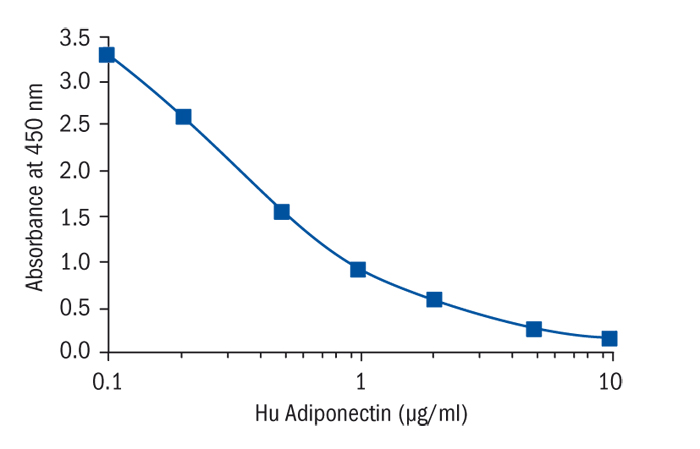
Calibration Curve

Calibration range

0.1 to 10 µg/ml

Limit of detection

Analytical Limit of Detection is calculated from the real human adiponectin values in wells and is 7ng/ml.

Limit of quantification

Assay Sensitivity takes the dilution of samples into consideration and is calculated according to the formula: Assay Sensitivity = Analytical Limit of Detection x sample dilution = 7ng/ml x 30 = 210ng/ml

Intra-assay (Within-Run, n=8)

CV = 6.7 %

Inter-assay (Run-to-Run, n=8)

CV = 5.0 %

Spiking Recovery

93 %

Dilution Linearity

95 %

Cross-Reactivity

Human, monkey

References to this product

  • Mohlig M, Freudenberg M, Bobbert T, Ristow M, Rochlitz H, Weickert MO, Pfeiffer AF, Spranger J . Acetylsalicylic acid improves lipid-induced insulin resistance in healthy men. J Clin Endocrinol Metab . Mar;91(3):964-7 (2006)
  • Pilz S, Mangge H, Wellnitz B, Seelhorst U, Winkelmann BR, Tiran B, Boehm BO, Marz W . Adiponectin and mortality in patients undergoing coronary angiography. J Clin Endocrinol Metab . Nov;91(11):4277-86 (2006)
  • Bersinger NA, Birkhauser MH, Wunder DM . Adiponectin as a marker of success in intracytoplasmic sperm injection/embryo transfer cycles. Gynecol Endocrinol . Sep;22(9):479-83 (2006)
  • Stejskal D, Ruzicka V, Adamovska S, Jurakova R, Proskova J, Jedelsky L, Bartek J . Adiponectin concentrations as a criterion of metabolic control in persons with type 2 diabetes mellitus?. Biomed Pap Med Fac Univ Palacky Olomouc Czech Repub . Dec;147(2):167-72 (2003)
  • Spranger J, Verma S, Gohring I, Bobbert T, Seifert J, Sindler AL, Pfeiffer A, Hileman SM, Tschop M, Banks WA . Adiponectin does not cross the blood-brain barrier but modifies cytokine expression of brain endothelial cells. Diabetes . Jan;55(1):141-7 (2006)
  • Stejskal D, Bartek J . Adiponectin in patients with various stages of coronary heart disease - comparison of its concentration in coronary arteries and peripheral venous circulation. Biomed Pap Med Fac Univ Palacky Olomouc Czech Repub . Dec;147(2):161-6 (2003)
  • Pilz S, Maerz W, Weihrauch G, Sargsyan K, Almer G, Nauck M, Boehm BO, Winkelmann BR, Mangge BR . Adiponectin serum concentrations in men with coronary artery disease: the LUdwigshafen RIsk and Cardiovascular Health (LURIC) study. Clin Chim Acta . Feb;364(1-2):251-5 (2006)
  • Bronsky J, Karpisek M, Bronska E, Pechova M, Jancikova B, Kotolova H, Stejskal D, Prusa R, Nevoral J . Adiponectin, adipocyte fatty acid binding protein, and epidermal fatty acid binding protein: proteins newly identified in human breast milk. Clin Chem . Sep;52(9):1763-70 (2006)
  • Mojiminiyi OA, Abdella NA, Al Arouj M, Ben Nakhi A . Adiponectin, insulin resistance and clinical expression of the metabolic syndrome in patients with Type 2 diabetes. Int J Obes (Lond) . Jun 6 (2006)
  • Giri S, Rattan R, Hag E, Khan M, Yasmin R, Won JS, Key L, Singh AK, Singh I . AICAR inhibits adipocyte differentiation in 3T3L1 and restores metabolic alterations in diet-induced obesity mice model. Nutr Metab (Lond) . Aug 10;3:31 (2006)
  • Dieplinger, B, Poelz W, Haltmayer M, Mueller T . Association of adiponectin and amino terminal proBNP in peripheral arterial disease. Clin Chem . Sep 30 (2006)
  • Moro C, Klimcakova E, Lolmede K, Berlan M, Lafontan M, Stich V, Bouloumie A, Galitzky J, Arner P, Langin D . Atrial natriuretic peptide inhibits the production of adipokines and cytokines linked to inflammation and insulin resistance in human subcutaneous adipose tissue. Diabetologia . May;50(5):1038-47 (2007)
  • Weickert MO, Mohlig M, Schofl C, Arafat AM, Otto B, Viehoff H, Koebnick C, Kohl A, Spranger J, Pfeiffer AF . Cereal fiber improves whole-body insulin sensitivity in overweight and obese women. Diabetes Care . Apr;29(4):775-80 (2006)
  • Bobbert A, Rochlitz H, Wegewitz U, Akpulat S, Mai K, Weickert MO, Mohlig M, Pfeiffer AF, Spranger J . Changes of adiponectin oligomer composition by moderate weight reduction. Diabetes . Sep;54(9):2712-9 (2005)
  • Delfini E, Petramala L, Caliumi C, Cotesta D, De Toma G, Cavallaro G, Panzironi G, Diacinti D, Minisola S, D' Erasmo E, Mazzuoli GF, Letizia C . Circulating leptin and adiponectin levels in patients with primary hyperparathyroidism. Metabolism . Jan;56(1):30-6 (2007)
  • Pilz S, Horejsi R, Moller R, Almer G, Scharnagl H, Stojakovic T, Dimitrova R, Weihrauch G, Borkenstein M, Maerz W, Schauenstein K, Mangge H . Early atherosclerosis in obese juveniles is associated with low serum levels of adiponectin. J Clin Endocrinol Metab . May 31 (2005)
  • Risch L, Guenter H, Saely C, Berchthold S, Weber M, Gouya G, Rein P, Langer P, Marte T, Aczel S, Drexel H . Evaluation of two fully automated novel enzyme-linked immunosorbent assays for the determination of human adiponectin in serum. Clin Chim Acta . Nov;373(1-2):121-6 (2006)
  • Westphal S, Borucki K, Taneva E, Makarova R, Luley C . Extended-release niacin raises adiponectin and leptin. Atherosclerosis . Aug 1 (2006)
  • Ben Yahia R, Lichnovska R, Gwozdiewiczova S, Kuzmina G, Chlup R, Luza J, Karpisek M, Brychta T, Petrek J . Fatty Acid Binding Proteins (FABPS) in relation to significant metabolic syndrome markers in diabetic patients and non-diabetic persons - pilot study.
  • Stejskal D, Ruzicka V, Fanfrdlova G, Kolar V, Bartek J . High adiponectin and TNF-alpha levels in moderate drinkers suffering from liver steatosis: comparison with non drinkers suffering from similar hepatopathy. Biomed Pap Med Fac Univ Palacky Olomouc Czech Repub . Jun;149(1):93-9 (2005)
  • Dieplinger B, Poelz W, Haltmayer M, Mueller T . Hypoadiponectinemia is associated with symptomatic atherosclerotic peripheral arterial disease. Clin Chem Lab Med . 44(7):830-3 (2006)
  • Otto C, Otto B, Goke B, Pfeiffer AF, Lehrke M, Vogeser M, Spranger J, Parhofer KG . Increase in adiponectin levels during pioglitazone therapy in relation to glucose control, insulin resistance as well as ghrelin and resistin levels. J Endocrinol Invest . Mar;29(3):231-6 (2006)
  • Senolt L, Pavelka K, Housa D, Haluzik M . Increased adiponectin is negatively linked to the local inflammatory process in patients with rheumatoid arthritis. Cytokine . Sep;35(5-6):247-52 (2006)
  • Shin MJ, Lee JH, Jang Y, Park E, Oh J, Chung JH, Chung N: . Insulin resistance, adipokines, and oxidative stress in nondiabetic, hypercholesterolemic patients: leptin as an 8-epi-prostaglandin F2alpha determinant. Metabolism . Jul;55(7):918-22 (2006)
  • Saely CH, Risch L, Hoefle G, Rein P, Muendlein A, Marte T, Aczel S, Langer P, Drexel H . Low serum adiponectin is independently associated with both the metabolic syndrome and angiographically determined coronary atherosclerosis. Clin Chim Acta . Aug;383(1-2):97-102 (2007)
  • Nawroth PP . Niedrige Konzentration des Hormons Adiponektin im Blut zeigt starke Verkaltung der Herzkranzgefässe an. 2006
  • Avignon A, Sultan A, Piot C, Elaerts S, Cristol JP, Dupuy AM . Osteoprotegerin is associated with silent coronary artery disease in high-risk but asymptomatic type 2 diabetic patients. Diabetes Care . Sep;28(9):2176-80 (2005)
  • Vitkova M, Klimcakova E, Kovacikova M, Valle C, Moro C, Polak J, Hanacek J, Capel F, Viguerie N, Richterova B, Bajzova M, Hejnova J, Stich V, Langin D . Plasma levels and adipose tissue messenger ribonucleic acid expression of retinol-binding protein 4 are reduced during calorie restriction in obese subjects but are not related to diet-induced changes in insulin sensitivity. J Clin Endocrinol Metab . Jun;92(6):2330-5 (2007)
  • Gomez-Ambrosi J, Catalan V, Ramirez B, Rodriguez A, Colina I, Silva C, Rotellar F, Mugueta C, Gil MJ, Cienfuegos JA, Salvador J, Fruhbeck G . Plasma osteopontin levels and expression in adipose tissue are increased in obesity. J Clin Endocrinol Metab . Sep;92(9):3719-27 (2007)
  • Vaverkova H, Karasek D, Novotny D, Jackuliakova D, Halenka M, Lukes J, Frohlich J . Positive association of adiponectin with soluble vascular cell adhesion molecule sVCAM-1 levels in patients with vascular disease or dyslipidemia. Atherosclerosis . Aug 21 (2007)
  • Bersinger NA, Smarason AK . Pre-eclampsia: increased, unchanged, and decreased serum markers in comparison to healthy third trimester pregnancy. A synopsis. Immuno-analyse et biologie spÚcialisÚe . 20: 353-359 (2005)
  • Tsioufis C, Dimitriadis K, Chatzis D, Vasiliadou C, Tousoulis D, Papademetriou V, Toutouzas P, Stefanadis C, Kallikazaros I . Relation of microalbuminuria to adiponectin and augmented C-reactive protein levels in men with essential hypertension. Am J Cardiol . Oct 1;96(7):946-51 (2005)
  • Risch L, Saely C, Hoefle G, Rein P, Langer P, Gouya G, Marte T, Aczel S, Drexel, H . Relationship between glomerular filtration rate and the adipokines adiponectin, resistin and leptin in coronary patients with predominantly normal or mildly impaired renal function. Clin Chim Acta . Jul 29 (2006)
  • von Eynatten M, Hamann A, Twardella D, Nawroth PP, Brenner H, Rothenbacher D . Relationship of adiponectin with markers of systemic inflammation, atherogenic dyslipidemia, and heart failure in patients with coronary heart disease. Clin Chem . May;52(5):853-9 (2006)
  • Shin M-J, Kang S-M, Jang Y, Lee JH, Oh J, Chung JH, Chung N . Serum retinol binding protein 4 levels are associated with serum adiponectin levels in non-diabetic, non-obese subjects with hypercholesterolemia. Clinica Chimica Acta . -2006
  • Catalan V, Gomez-Ambrosi J, Rotellar F, Silva C, Gil MJ, Rodriguez A, Cienfuegos JA, Salvador J, Fruhbeck G . The obestatin receptor (GPR39) is expressed in human adipose tissue and is down-regulated in obesity-associated type 2 diabetes mellitus. Clin Endocrinol (Oxf) . Apr;66(4):598-601 (2007)
  • Karaduman M, Sengul A, Oktenli C, Pekel A, Yesilova Z, Musabak U, Sanisoglu SY, Gunay C, Baysan O, Kocar IH, Tatr H, Ozata M . Tissue levels of adiponectin, tumour necrosis factor-alpha, soluble intercellular adhesion molecule-1 and heart-type fatty acid-binding protein in human coronary atherosclerotic plaques. Clin Endocrinol (Oxf) . Feb;64(2):196-202 (2006)

References to summary

  • Lam KS, Xu A. Adiponectin: protection of the endothelium. Curr Diab Rep. 2005, 5, 254–259.
  • Ding X, Saxena NK, Lin S, Xu A, Srinivasan S, Anania FA. The roles of leptin and adiponectin: a novel paradigm in adipocytokine regulation of liver fibrosis and stellate cell biology. Am J Pathol. 2005, 166, 1655–1669.
  • Xu A, Chan KW, Hoo RL, Wang Y, Tan KC, Zhang J, Chen B, Lam MC, Tse C, Cooper GJ, Lam KS. Testosterone selectively reduces the high molecular weight form of adiponectin by inhibiting its secretion from adipocytes. J Biol Chem. 2005, 280, 18073–18080.
  • Wang Y, Lam KS, Xu JY, Lu G, Xu LY, Cooper GJ, Xu A. Adiponectin inhibits cell proliferation by interacting with several growth factors in an oligomerization-dependent manner. J Biol Chem. 2005, 280, 18341–18347.
  • Ouchi N, Kobayashi H, Kihara S, Kumada M, Sato K, Inoue T, Funahashi T, Walsh K. Adiponectin stimulates angiogenesis by promoting cross-talk between AMP-activated protein kinase and Akt signaling in endothelial cells. J Biol Chem. 2004, 279, 1304–1309.
  • Ishikawa Y, Akasaka Y, Ishii T, Yoda-Murakami M, Choi-Miura NH, Tomita M, Ito K, Zhang L, Akishima Y, Ishihara M, Muramatsu M, Taniyama M. Changes in the distribution pattern of gelatinbinding protein of 28 kDa (adiponectin) in myocardial remodelling after ischaemic injury. Histopathology. 2003, 42, 43–52.
  • Diez JJ, Iglesias P. The role of the novel adipocyte-derived hormone adiponectin in human disease. Eur J Endocrinol. 2003, 148, 293–300.
  • Waki H, Yamauchi T, Kamon J, Ito Y, Uchida S, Kita S, Hara K, Hada Y, Vasseur F, Froguel P, Kimura S, Nagai R, Kadowaki T. Impaired multimerization of human adiponectin mutants associated with diabetes. Molecular structure and multimer formation of adiponectin. J Biol Chem. 2003, 278, 40352–40363.
  • Yamauchi T, Kamon J, Ito Y, Tsuchida A, Yokomizo T, Kita S, Sugiyama T, Miyagishi M, Hara K, Tsunoda M, Murakami K, Ohteki T, Uchida S, Takekawa S, Waki H, Tsuno NH, Shibata Y, Terauchi Y, Froguel P, Tobe K, Koyasu S, Taira K, Kitamura T, Shimizu T, Nagai R, Kadowaki T. Cloning of adiponectin receptors that mediate antidiabetic metabolic effects. Nature. 2003, 423, 762–769.
  • Yamauchi T, Kamon J, Waki H, Imai Y, Shimozawa N, Hioki K, Uchida S, Ito Y, Takakuwa K, Matsui J, Takata M, Eto K, Terauchi Y, Komeda K, Tsunoda M, Murakami K, Ohnishi Y, Naitoh T, Yamamura K, Ueyama Y, Froguel P, Kimura S, Nagai R, Kadowaki T. Globular adiponectin protected ob/ob mice from diabetes and ApoE-deficient mice from atherosclerosis. J Biol Chem. 2003, 278, 2461–2468.
  • Daimon M, Oizumi T, Saitoh T, Kameda W, Hirata A, Yamaguchi H, Ohnuma H, Igarashi M, Tominaga M, Kato T. Decreased serum levels of adiponectin are a risk factor for the progression to type 2 diabetes in the Japanese Population: the Funagata study. Diabetes Care. 2003 Jul;26(7):2015–20.
  • Pajvani UB, Du X, Combs TP, Berg AH, Rajala MW, Schulthess T, Engel J, Brownlee M, Scherer PE. Structure-function studies of the adipocyte-secreted hormone Acrp30/adiponectin. Implications for metabolic regulation and bioactivity. J Biol Chem. 2003, 278, 9073–9085.
  • Spranger J, Kroke A, Mohlig M, Bergmann MM, Ristow M, Boeing H, Pfeiffer AF. Adiponectin and protection against type 2 diabetes mellitus. Lancet. 2003, 361, 226–228.
  • Kondo H, Shimomura I, Matsukawa Y, Kumada M, Takahashi M, Matsuda M, Ouchi N, Kihara S, Kawamoto T, Sumitsuji S, Funahashi T, Matsuzawa Y. Association of adiponectin mutation with type 2 diabetes: a candidate gene for the insulin resistance syndrome. Diabetes. 2002, 51, 2325–2328.
  • Wang Y, Xu A, Knight C, Xu LY, Cooper GJ. Hydroxylation and glycosylation of the four conserved lysine residues in the collagenous domain of adiponectin. Potential role in the modulation of its insulin-sensitizing activity. J Biol Chem. 2002, 277, 19521–19529.
  • Tsao TS, Lodish HF, Fruebis J. ACRP30, a new hormone controlling fat and glucose metabolism. Eur J Pharmacol. 2002, 440, 213–21.
  • Das K, Lin Y, Widen E, Zhang Y, Scherer PE. Chromosomal localization, expression pattern, and promoter analysis of the mouse gene encoding adipocyte-specific secretory protein Acrp30. Biochem Biophys Res Commun. 2001, 280, 1120–1129.
  • Yokota T, Oritani K, Takahashi I, Ishikawa J, Matsuyama A, Ouchi N, Kihara S, Funahashi T, Tenner AJ, Tomiyama Y, Matsuzawa Y. Adiponectin, a new member of the family of soluble defense collagens, negatively regulates the growth of myelomonocytic progenitors and the functions of macrophages. Blood. 2000, 96, 1723–1732.
  • Saito K, Tobe T, Minoshima S, Asakawa S, Sumiya J, Yoda M, Nakano Y, Shimizu N, Tomita M. Organization of the gene for gelatin-binding protein (GBP28). Gene. 1999, 229, 67–73.
  • Arita Y, Kihara S, Ouchi N, Takahashi M, Maeda K, Miyagawa J, Hotta K, Shimomura I, Nakamura T, Miyaoka K, Kuriyama H, Nishida M, Yamashita S, Okubo K, Matsubara K, Muraguchi M, Ohmoto Y, Funahashi T, Matsuzawa Y. Paradoxical decrease of an adipose-specific protein, adiponectin, in obesity. Biochem Biophys Res Commun. 1999, 257, 79–83.
  • Maeda K, Okubo K, Shimomura I, Funahashi T, Matsuzawa Y, Matsubara K. cDNA cloning and expression of a novel adipose specific collagen-like factor, apM1 (adipose most abundant gene transcript 1). Biochem Biophys Res Commun. 1996, 221, 286–289.
  • Scherer PE, Williams S, Fogliano M, Baldini G, Lodish HF. A novel serum protein similar to C1q, produced exclusively in adipocytes. J Biol Chem. 1995, 270, 26746–26749.


Shopping cart

Your cart is empty.