You are here: Products\Immunoassays\Adiponectin Human ELISA, High Sensitivity (Sandwich):

Adiponectin Human ELISA, High Sensitivity (Sandwich)

Product of BioVendor
Other names: Acrp30, GBP28, AdipoQ
Cat. No.: RD191023100 Regulatory status: RUO
Size: 96 wells (1 kit) |
Cat. No.: RD191023100 Regulatory status: IVD CE
Size: 96 wells (1 kit) |
Files: Datasheet PDF (RUO) Datasheet PDF (IVD CE) MSDS (RUO) MSDS (IVD CE)
Legend: new product new product
discount discount
temporarily out of stock temporarily out of stock
book in advance order in advance

Research topic

Energy metabolism and body weight regulation

Features

  • The total assay time is less than three hours.
  • The kit measures total adiponectin.
  • Standards are human serum based.
  • Quality controls are human serum based. No animal sera are used.
  • Components of the kit are ready-to-use (with the exception of Dilution Bufer and Wash Solution).

Storage/Shipping

Store the kit at 2 8°C. Under these conditions, assay components are stable till the expiry date is over. (See the expiry date indicated on the kit label).

Summary

Adiponectin, also referred to as Acrp30, AdipoQ and GBP-28, is a recently discovered 244 aminoacid protein, the product of the apM1 gene, which is physiologically active and specifically and highly expressed in adipose cells. The protein belongs to the soluble defence collagen superfamily; it has a collagen-like domain structurally homologous with collagen VIII and X and complement factor C1q-like globular domain. Adiponectin forms homotrimers, which are the building blocks for higher order complexes found circulating in serum. Together, these complexes make up approximately 0.01% of total serum protein. Adiponectin receptors AdipoR1 and AdipoR2 have been recently cloned; AdipoR1 is abundantly expressed in skeletal muscle, whereas AdipoR2 is predominantly expressed in the liver. Paradoxically, adipose tissue-expressed adiponectin levels are inversely related to the degree of adiposity. Adiponectin concentrations correlate negatively with glucose, insulin, triglyceride concentrations, liver fat content and body mass index and positively with high-density lipoprotein-cholesterol levels, hepatic insulin sensitivity and insulin-stimulated glucose disposal. Adiponectin has been shown to increase insulin sensitivity and decrease plasma glucose by increasing tissue fat oxidation. Of particular interest is that low adiponectin serum levels predict type 2 diabetes independent of other risk factors. Adiponectin also inhibits the inflammatory processes of atherosclerosis suppressing the expression of adhesion and cytokine molecules in vascular endothelial cells and macrophages, respectively. This adipokine plays a role as a scaffold of newly formed collagen in myocardial remodelling after ischaemic injury and also stimulates angiogenesis by promoting cross-talk between AMP-activated protein kinase and Akt signalling in endothelial cells. Low serum adiponectin levels are found in patients with coronary artery disease. Moreover, high circulating levels of adiponectin are associated with decreased risk of myocardial infarction, independent of other factors. Altogether, adiponectin has the potential to become a clinically relevant parameter to be measured routinely in subjects at risk for type 2 diabetes, atherosclerosis and the metabolic syndrome.

Assay format

Sandwich ELISA, HRP-labelled antibody

Sample requirements

10 µl/well

Applications

Cell culture medium, Cerebrospinal fluid, Milk, Plasma-Citrate, Plasma-EDTA, Plasma-Heparin, Serum, Urine

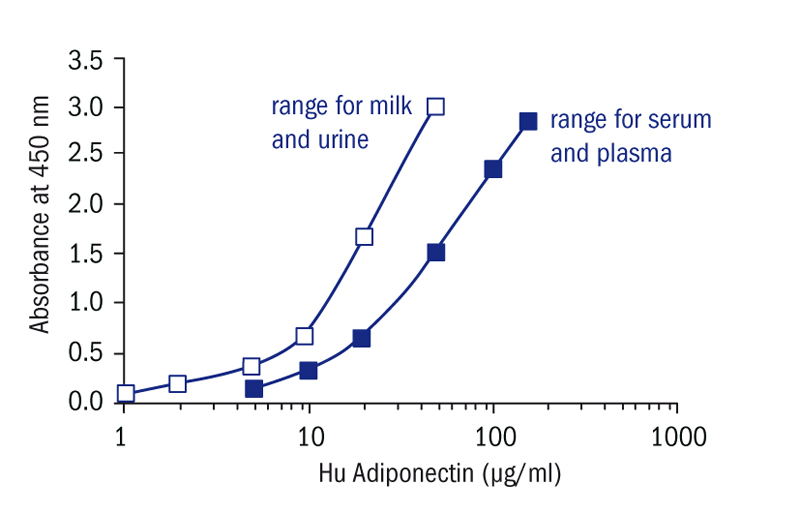
Calibration Curve

Calibration range

1 to 150 ng/ml

Limit of detection

Analytical Limit of Detection:

  • For serum or plasma samples: Analytical Limit of Detection is calculated from the real adiponectin values in wells and is: 0.47 ng/ml
  • For milk, CSF or urine: Analytical Limit of Detection is calculated from the real adiponectin values in wells and is: 0.156 ng/ml

Limit of quantification

Assay Sensitivity

  • For serum or plasma samples: Assay Sensitivity takes the dilution of samples into consideration and is calculated according to the formula:

Assay Sensitivity = Analytical Limit of Detection x sample dilution = 0.47 ng/ml x 300 = 141 ng/ml

  • For milk, CSF of urine: Assay Sensitivity takes the dilution of samples into consideration and is calculated according to the formula:

Assay Sensitivity = Analytical Limit of Detection x sample dilution = 0.156 ng/ml x 3 = 0.468 ng/ml

Intra-assay (Within-Run, n=8)

CV = 5.5 %

Inter-assay (Run-to-Run, n=8)

CV = 8.5 %

Spiking Recovery

91 %

Dilution Linearity

92 %

Cross-Reactivity

Human, Cat, Dog, Hamster, Monkey, Rat

Find out more on biovendor.com

References to this product

  • Stejskal D, Proskova J, Solichova P. Adiponectin added into the plasma of healthy probands does not affect platelet aggregability. Biomed Pap Med Fac Univ Palack. 2006 Jul;150 (1):89-90
  • Bobbert T, Wegewitz U, Brechtel L, Freudenberg M, Mai K, Mohlig M, Diederich S, Ristow M, Rochlitz H, Pfeiffer AF, Spranger J. Adiponectin oligomers in human serum during acute and chronic exercise: relation to lipid metabolism and insulin sensitivity. Int J Sports Med. 2007 Jan;28 (1):1-8
  • Bronsky J, Karpisek M, Bronska E, Pechova M, Jancikova B, Kotolova H, Stejskal D, Prusa R, Nevoral J. Adiponectin, adipocyte fatty acid binding protein, and epidermal fatty acid binding protein: proteins newly identified in human breast milk. Clin Chem. 2006 Sep;52 (9):1763-70
  • Lamounier-Zepter V, Bornstein SR, Kunes J, Zicha J, Krsek M, Ehrhart-Bornstein M, Ziegler CG, Kiessling A, Funk RH, Haluzik M. Adrenocortical changes and arterial hypertension in lipoatrophic A-ZIP/F-1 mice. Mol Cell Endocrinol. 2008 Jan 2;280 (1-2):39-46
  • Schnabel R, Messow CM, Lubos E, Espinola-Klein C, Rupprecht HJ, Bickel C, Sinning C, Tzikas S, Keller T, Genth-Zotz S, Lackner KJ, Munzel TF, Blankenberg S. Association of adiponectin with adverse outcome in coronary artery disease patients: results from the AtheroGene study. Eur Heart J. 2008 Mar;29 (5):649-57
  • Benedict C, Kern W, Schultes B, Born J, Hallschmid M. Differential sensitivity of men and women to anorexigenic and memory-improving effects of intranasal insulin. J Clin Endocrinol Metab. 2008 Apr;93 (4):1339-44
  • Serelis J, Kontogianni MD, Katsiougiannis S, Bletsa M, Tektonidou MG, Skopouli FN. Effect of anti-TNF treatment on body composition and serum adiponectin levels of women with rheumatoid arthritis. Clin Rheumatol. 2008 Jun;27 (6):795-7
  • Marinoni E, Letizia C, Ciardo F, Corona G, Moscarini M, Di Iorio R. Effects of prenatal betamethasone administration on leptin and adiponectin concentrations in maternal and fetal circulation. Am J Obstet Gynecol. 2008 Aug;199 (2):141.e1-6
  • Risch L, Guenter H, Saely C, Berchthold S, Weber M, Gouya G, Rein P, Langer P, Marte T, Aczel S, Drexel H . Evaluation of two fully automated novel enzyme-linked immunosorbent assays for the determination of human adiponectin in serum. Clin Chim Acta . Nov;373(1-2):121-6 (2006)
  • Catalan V, Gomez-Ambrosi J, Rodriguez A, Silva C, Rotellar F, Gil MJ, Cienfuegos JA, Salvador J, Fruhbeck G. Expression of caveolin-1 in human adipose tissue is upregulated in obesity and obesity-associated type 2 diabetes mellitus and related to inflammation. Clin Endocrinol (Oxf). 2008 Feb;68 (2):213-9
  • Baranova A, Gowder SJ, Schlauch K, Elariny H, Collantes R, Afendy A, Ong JP, Goodman Z, Chandhoke V, Younossi ZM. Gene expression of leptin, resistin, and adiponectin in the white adipose tissue of obese patients with non-alcoholic fatty liver disease and insulin resistance. Obes Surg. 2006 Sep;16 (9):1118-25
  • Catalan V, Gomez-Ambrosi J, Pastor C, Rotellar F, Silva C, Rodriguez A, Gil MJ, Cienfuegos JA, Salvador J, Vendrell J, Fruhbeck G. Influence of morbid obesity and insulin resistance on gene expression levels of AQP7 in visceral adipose tissue and AQP9 in liver. Obes Surg. 2008 Jun;18 (6):695-701
  • Chu MC, Cosper P, Orio F, Carmina E, Lobo RA. Insulin resistance in postmenopausal women with metabolic syndrome and the measurements of adiponectin, leptin, resistin, and ghrelin. Am J Obstet Gynecol. 2006 Jan;194 (1):100-4
  • Corpeleijn E, Feskens EJ, Jansen EH, Mensink M, Saris WH, Blaak EE . Lifestyle intervention and adipokine levels in subjects at high risk for type 2 diabetes: the Study on Lifestyle intervention and Impaired glucose tolerance Maastricht (SLIM). Diabetes Care . Dec;30(12):3125-7 (2007)
  • Tsioufis C, Dimitriadis K, Selima M, Thomopoulos C, Mihas C, Skiadas I, Tousoulis D, Stefanadis C, Kallikazaros I. Low-grade inflammation and hypoadiponectinaemia have an additive detrimental effect on aortic stiffness in essential hypertensive patients. Eur Heart J. 2007 May;28 (9):1162-9
  • Avignon A, Sultan A, Piot C, Mariano-Goulart D, Thuan Dit Dieudonne JF, Cristol JP, Dupuy AM. Osteoprotegerin: a novel independent marker for silent myocardial ischemia in asymptomatic diabetic patients. Diabetes Care. 2007 Nov;30 (11):2934-9
  • Efstathiou SP, Tsioulos DI, Tsiakou AG, Gratsias YE, Pefanis AV, Mountokalakis TD . Plasma adiponectin levels and five-year survival after first-ever ischemic stroke. Stroke . Sep;36(9):1915-9 (2005)
  • Gomez-Ambrosi J, Catalan V, Ramirez B, Rodriguez A, Colina I, Silva C, Rotellar F, Mugueta C, Gil MJ, Cienfuegos JA, Salvador J, Fruhbeck G . Plasma osteopontin levels and expression in adipose tissue are increased in obesity. J Clin Endocrinol Metab . Sep;92(9):3719-27 (2007)
  • Vaverkova H, Karasek D, Novotny D, Jackuliakova D, Halenka M, Lukes J, Frohlich J. Positive association of adiponectin with soluble vascular cell adhesion molecule sVCAM-1 levels in patients with vascular disease or dyslipidemia. Atherosclerosis. 2008 Apr;197 (2):725-31
  • Catalan V, Gomez-Ambrosi J, Ramirez B, Rotellar F, Pastor C, Silva C, Rodriguez A, Gil MJ, Cienfuegos JA, Fruhbeck G. Proinflammatory cytokines in obesity: impact of type 2 diabetes mellitus and gastric bypass. Obes Surg. 2007 Nov;17 (11):1464-74
  • Golledge J, Jayalath R, Oliver L, Parr A, Schurgers L, Clancy P. Relationship between CT anthropometric measurements, adipokines and abdominal aortic calcification. Atherosclerosis. 2008 Mar;197 (1):428-34
  • Risch L, Saely C, Hoefle G, Rein P, Langer P, Gouya G, Marte T, Aczel S, Drexel, H . Relationship between glomerular filtration rate and the adipokines adiponectin, resistin and leptin in coronary patients with predominantly normal or mildly impaired renal function. Clin Chim Acta . Jul 29 (2006)
  • Cabre A, Lazaro I, Girona J, Manzanares J, Marimon F, Plana N, Heras M, Masana L. Retinol-binding protein 4 as a plasma biomarker of renal dysfunction and cardiovascular disease in type 2 diabetes. J Intern Med. 2007 Oct;262 (4):496-503
  • Otto C, Otto B, Frost RJ, Vogeser M, Pfeiffer AF, Spranger J, Parhofer KG. Short-term therapy with atorvastatin or fenofibrate does not affect plasma ghrelin, resistin or adiponectin levels in type 2 diabetic patients with mixed hyperlipoproteinaemia. Acta Diabetol. 2007 Jun;44 (2):65-8
  • Karapanagiotou EM, Tsochatzis EA, Dilana KD, Tourkantonis I, Gratsias I, Syrigos KN. The significance of leptin, adiponectin, and resistin serum levels in non-small cell lung cancer (NSCLC). Lung Cancer. 2008 Mar 12;
  • Polak J, Kovacova Z, Holst C, Verdich C, Astrup A, Blaak E, Patel K, Oppert JM, Langin D, Martinez JA, Sorensen TI, Stich V. Total adiponectin and adiponectin multimeric complexes in relation to weight loss-induced improvements in insulin sensitivity in obese women: the NUGENOB study. Eur J Endocrinol. 2008 Apr;158 (4):533-41

References to summary

  • Martin LJ, Banach W, Dolan L, Davidson BS, Geraghty SR, Morrow AL. Presence of Adiponectin and Leptin in Human Milk. 2004 Pediatric Academic Societies' Annual Meeting, http://www.abstracts2view.com/…ionindex.php
  • Pilz S, Horejsi R, Moller R, Almer G, Scharnagl H, Stojakovic T, Dimitrova R, Weihrauch G, Borkenstein M, Maerz W, Schauenstein K, Mangge H: Early atherosclerosis in obese juveniles is associated with low serum levels of adiponectin. J Clin Endocrinol Metab. May 31 (2005) [Epub ahead of print]
  • Scherer PE, Williams S, Fogliano M, Baldini G, Lodish HF. A novel serum protein similar to C1q, produced exclusively in adipocytes. J Biol Chem. 1995, 270, 26746–26749.
  • Maeda K, Okubo K, Shimomura I, Funahashi T, Matsuzawa Y, Matsubara K. cDNA cloning and expression of a novel adipose specific collagen-like factor, apM1 (adipose most abundant gene transcript 1). Biochem Biophys Res Commun. 1996, 221, 286–289.
  • Arita Y, Kihara S, Ouchi N, Takahashi M, Maeda K, Miyagawa J, Hotta K, Shimomura I, Nakamura T, Miyaoka K, Kuriyama H, Nishida M, Yamashita S, Okubo K, Matsubara K, Muraguchi M, Ohmoto Y, Funahashi T, Matsuzawa Y. Paradoxical decrease of an adipose-specific protein, adiponectin, in obesity. Biochem Biophys Res Commun. 1999, 257, 79–83.
  • Saito K, Tobe T, Minoshima S, Asakawa S, Sumiya J, Yoda M, Nakano Y, Shimizu N, Tomita M. Organization of the gene for gelatin-binding protein (GBP28). Gene. 1999, 229, 67–73.
  • Yokota T, Oritani K, Takahashi I, Ishikawa J, Matsuyama A, Ouchi N, Kihara S, Funahashi T, Tenner AJ, Tomiyama Y, Matsuzawa Y. Adiponectin, a new member of the family of soluble defense collagens, negatively regulates the growth of myelomonocytic progenitors and the functions of macrophages. Blood. 2000, 96, 1723–1732.
  • Das K, Lin Y, Widen E, Zhang Y, Scherer PE. Chromosomal localization, expression pattern, and promoter analysis of the mouse gene encoding adipocyte-specific secretory protein Acrp30. Biochem Biophys Res Commun. 2001, 280, 1120–1129.
  • Tsao TS, Lodish HF, Fruebis J. ACRP30, a new hormone controlling fat and glucose metabolism. Eur J Pharmacol. 2002, 440, 213–21.
  • Wang Y, Xu A, Knight C, Xu LY, Cooper GJ. Hydroxylation and glycosylation of the four conserved lysine residues in the collagenous domain of adiponectin. Potential role in the modulation of its insulin-sensitizing activity. J Biol Chem. 2002, 277, 19521–19529.
  • Kondo H, Shimomura I, Matsukawa Y, Kumada M, Takahashi M, Matsuda M, Ouchi N, Kihara S, Kawamoto T, Sumitsuji S, Funahashi T, Matsuzawa Y. Association of adiponectin mutation with type 2 diabetes: a candidate gene for the insulin resistance syndrome. Diabetes. 2002, 51, 2325–2328.
  • Spranger J, Kroke A, Mohlig M, Bergmann MM, Ristow M, Boeing H, Pfeiffer AF. Adiponectin and protection against type 2 diabetes mellitus. Lancet. 2003, 361, 226–228.
  • Pajvani UB, Du X, Combs TP, Berg AH, Rajala MW, Schulthess T, Engel J, Brownlee M, Scherer PE. Structure-function studies of the adipocyte-secreted hormone Acrp30/adiponectin. Implications for metabolic regulation and bioactivity. J Biol Chem. 2003, 278, 9073–9085.
  • Daimon M, Oizumi T, Saitoh T, Kameda W, Hirata A, Yamaguchi H, Ohnuma H, Igarashi M, Tominaga M, Kato T. Decreased serum levels of adiponectin are a risk factor for the progression to type 2 diabetes in the Japanese Population: the Funagata study. Diabetes Care. 2003 Jul;26(7):2015–20.
  • Yamauchi T, Kamon J, Waki H, Imai Y, Shimozawa N, Hioki K, Uchida S, Ito Y, Takakuwa K, Matsui J, Takata M, Eto K, Terauchi Y, Komeda K, Tsunoda M, Murakami K, Ohnishi Y, Naitoh T, Yamamura K, Ueyama Y, Froguel P, Kimura S, Nagai R, Kadowaki T. Globular adiponectin Human Adiponectin ELISA, High Sensitivity (page 19 of 24) VERSION 15 130607 08 protected ob/ob mice from diabetes and ApoE-deficient mice from atherosclerosis. J Biol Chem. 2003, 278, 2461–2468.
  • Yamauchi T, Kamon J, Ito Y, Tsuchida A, Yokomizo T, Kita S, Sugiyama T, Miyagishi M, Hara K, Tsunoda M, Murakami K, Ohteki T, Uchida S, Takekawa S, Waki H, Tsuno NH, Shibata Y, Terauchi Y, Froguel P, Tobe K, Koyasu S, Taira K, Kitamura T, Shimizu T, Nagai R, Kadowaki T. Cloning of adiponectin receptors that mediate antidiabetic metabolic effects. Nature. 2003, 423, 762–769.
  • Waki H, Yamauchi T, Kamon J, Ito Y, Uchida S, Kita S, Hara K, Hada Y, Vasseur F, Froguel P, Kimura S, Nagai R, Kadowaki T. Impaired multimerization of human adiponectin mutants associated with diabetes. Molecular structure and multimer formation of adiponectin. J Biol Chem. 2003, 278, 40352–40363.
  • Diez JJ, Iglesias P. The role of the novel adipocyte-derived hormone adiponectin in human disease. Eur J Endocrinol. 2003, 148, 293–300.
  • Ishikawa Y, Akasaka Y, Ishii T, Yoda-Murakami M, Choi-Miura NH, Tomita M, Ito K, Zhang L, Akishima Y, Ishihara M, Muramatsu M, Taniyama M. Changes in the distribution pattern of gelatinbinding protein of 28 kDa (adiponectin) in myocardial remodelling after ischaemic injury. Histopathology. 2003, 42, 43–52.
  • Ouchi N, Kobayashi H, Kihara S, Kumada M, Sato K, Inoue T, Funahashi T, Walsh K. Adiponectin stimulates angiogenesis by promoting cross-talk between AMP-activated protein kinase and Akt signaling in endothelial cells. J Biol Chem. 2004, 279, 1304–1309.


Shopping cart

Your cart is empty.