Notice
For processing the stool samples we recommend using BioVendor Extraction Buffer. The reagent is not included and can be ordered separately (Cat. No.: C005821, 100 ml).
Please find the protocol for preparation and analysis of stool extracts in Docs.
Type
Sandwich ELISA, Biotin-labelled antibody
Applications
Stool, Serum, Plasma-EDTA, Urine
Sample Requirements
Serum and plasma: 10 µl/well
For processing the stool samples we recommend using BioVendor Extraction Buffer. The reagent is not included and can be ordered separately (Cat. No.: C005821, 100 ml).
Shipping
At ambient temperature. Upon receipt, store the product at the temperature recommended below.
Storage/Expiration
Store the kit at 2–8°C. Under these conditions, the kit is stable until the expiration date (see label on the box).
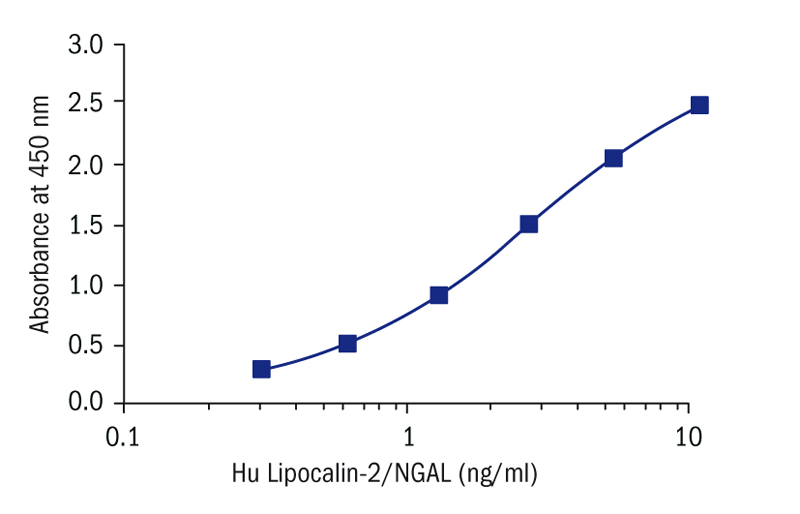
Calibration Curve
Calibration Range
0.3–10 ng/ml
Limit of Detection
0.02 ng/ml
Intra-assay (Within-Run)
n = 8; CV = 7.7%
Inter-assay (Run-to-Run)
n = 7; CV = 9.8%
Spiking Recovery
98,00%
Dilution Linearity
104,50%
Crossreactivity
- bovine Non-detectable
- cat Non-detectable
- dog Non-detectable
- goat Non-detectable
- hamster Non-detectable
- horse Non-detectable
- monkey Non-detectable
- mouse Non-detectable
- pig Non-detectable
- rabbit Non-detectable
- rat Non-detectable
- sheep Non-detectable
- chicken Not tested
- human Yes
Features
- It is intended for research use only
- The total assay time is less than 3.5 hours.
- The kit measures Lipocalin-2 in serum, plasma (EDTA, citrate, heparin), urine and stool extract
- For protocol for preparation of stool extracts and other details, please contact us at info@biovendor.com
- Assay format - 96 wells
- Quality controls are human serum based. No animal sera are used.
- Standard is recombinant protein based.
- Components of kit are provided ready to use, concentrated or lyophilized.
Research topic
Energy metabolism and body weight regulation, Renal disease
Summary
Lipocalin-2 (LCN2) is a 25 kDa secretory glycoprotein, also called NGAL (neutrophil gelatinase-associated lipocalin); NL (neutrophil lipocalin); p25; oncogen 24p3 and 25 kDa alpha-2-microglobulin-related subunit of MMP-9 (LCN2 forms a covalently linked, disulfide-bridged heterodimer with the 92 kDa type V collagenase (MMP-9)). LCN2 is predominantly expressed in adipose tissue and liver. It belongs to the lipocalin superfamily that consists of over 20 small secretory proteins. Lipocalin folds consist of 8 antiparallel ß-sheets that surround a hydrophobic pocket. A common feature of this protein family, following from its structure, is its capacity to bind and transport small lipophilic substancies such as free fatty acids, retinoids, arachidonic acid and various steroids. Although Lipocalin-2 was identified more than a decade ago, the physiologic function of this protein remains poorly understood. LCN2 appears to be upregulated in cells under the “stress” (e.g. from infection, inflammation, in tissues undergoing involution to ischemia or neoplastic transformation). Plasma levels of LCN2 rise in inflammatory or infective condition. It mediates an immune response to bacterial infection by sequestering iron. In this case, LCN2 may represent a promising candidate as a therapeutic agent against bacterial infection. Several recent reports suggest that LCN2 might represent a sensitive biomarker for early renal injury. In cardiopulmonary bypass-induced acute renal injury and cisplatin-induced nephrotoxic injury, increased de novo synthesis of LCN2 in proximal tubule cells leads to sharply increased concentration of this protein in both urine and serum. LCN2 might also be critical for normal kidney formation in the earliest stages of mammalian development. LCN2 may play an important role in breast cancer, in complex with MMP-9, by protecting MMP-9 from degradation thereby enhancing its enzymatic activity and facilitating angiogenesis and tumor growth. LCN2 is also highly expressed after malignant transformation of the lung, colon and pancreatic epithelia. Circulating levels of LCN2 play a causative role in pathogenesis of obesity-induced metabolic disorders such as insulin resistance, Type 2 Diabetes Mellitus and cardiovascular disorders. In addition, serum LCN2 concentrations were positively associated with adipocyte-fatty acid binding protein (A-FABP), a novel serum marker for adiposity and metabolic syndrome.
Areas of investigation: Bacterial infection Renal injury Angiogenesis Oncology Diabetes mellitus Metabolic syndrome
Features
Find documents for the lot
Example Instructions for Use (RUO)
Application protocol
Example Instructions for Use (RUO)
Safety Information (RUO)
MSDS (RUO)
MSDS (RUO)
MSDS (RUO)