Type
Sandwich ELISA, Biotin-labelled antibody
Applications
Serum, Plasma-Citrate
Sample Requirements
10 µl/well
Shipping
At ambient temperature. Upon receipt, store the product at the temperature recommended below.
Storage/Expiration
Store the complete kit at 2–8°C. Under these conditions, the kit is stable until the expiration date (see label on the box).
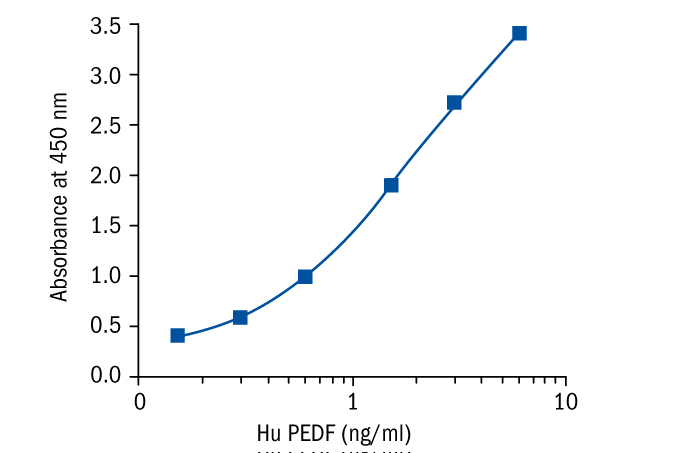
Calibration Curve
Calibration Range
0.15–6 ng/ml
Limit of Detection
0.045 ng/ml
Intra-assay (Within-Run)
n = 8; CV = 3.6%
Inter-assay (Run-to-Run)
n = 5; CV = 5.9%
Spiking Recovery
100,70%
Dilution Linearity
97,80%
Crossreactivity
- bovine Non-detectable
- cat Yes (recommended dilution 1:4000)
- dog Non-detectable
- goat Non-detectable
- hamster Non-detectable
- horse Non-detectable
- mouse Non-detectable
- pig Non-detectable
- rabbit Non-detectable
- rat Non-detectable
- sheep Non-detectable
- chicken Not tested
- human Yes
- monkey Yes (recommended dilution 1:4000)
Features
- It is intended for research use only
- The total assay time is less than 4 hours
- The kit measures PEDF in serum and citrate plasma
- Assay format is 96 wells
- Quality Controls are human serum based
- Standard is recombinant protein based
- Components of the kit are provided ready to use, concentrated or lyophilized
Research topic
Energy metabolism and body weight regulation, Others
Summary
PEDF is syntetized and released by human fetal retinal pigment epithelial cells (RPE) into the interphotoreceptor matrix and is localized to human chromosome 17p. It is a 50 kDa multifunctional glycoprotein belonging to the serpin protease inhibitor supergene (serpin) family, acting like substrates rather than inhibitors of serine proteases, being also described as serine peptidase inhibitor, clade F (alfa-2 antiplasmin, pigment epithelium derived factor), member 1. This gene encodes a 418 amino-acid protein with an asparagine glycosylation site at position 285–287 (Asn-Leu-Thr) and N-terminal signal peptide associated with secreted proteins. PEDF has an asymmetrical charge distribution, with a high density of basic residues concentrated on one side (positive) of the molecule and of acidic residues on the opposite side. Interactions of PEDF with three different types of molecules have been discovered: glycosaminoglycans of extracellular matrixes, collagens and receptors on the surface of neuronal cells. Negatively charged, acidic PEDF binds to collagen, lacks neurotrophic activity, and may confer antiangiogenic properties. PEDF has gliastatic, neuronotrophic, neuroprotective and antitumorigenic properties. PEDF acts in neuronal differentiation and survival in cells derived from retina and the central nervous system (CNS).Two functional epitopes have been identified on PEDF, a 34-mer peptide (residues 24–57) and a 44-mer peptide (residues 58–101). 44-mer peptide interacts with a a putative 80 kDa receptor (PEDFRN), identified on Y-79 cells (retinoblastoma cells), cerebellar and motor neurons, and in neural retina and replicates the neurotrophic function and the ability to block vascular leackage. The 34-mer peptide, possibly via a distinct receptor (PEDF-RA) identified on endothelial cells, induces apoptosis, blocks endothelial cell migration and corneal angiogenesis, but fails to induce Y-79 differentiation. Recently, PEDF was shown also to have potent anti-angiogenic activity as it specifically inhibited the migration of endothelial cells, an essential step in angiogenesis. Its activity equals or supersedes that of other anti-angiogenic factors, including angiostatin, endostatin and thrombospondin-1. In cell culture and in animal models, PEDF inhibited endothelial cell (EC) growth and migration and suppressed ischemia-induced neovascularization, whereas in porcine liver, the expression of PEDF has been associated with body muscularity and obesity. Analyses revealed that Human PEDF is correlated with BMI, CRP, diastolic blood pressure, insulin, Quicki. Individuals with metabolic syndrome (NCEP criterion) have significantly higher PEDF values than healthy subjects , suggesting that PEDF is and independent marker of MS with sufficient diagnostic efficacy.
Find documents for the lot
Example Instructions for Use (RUO)
Example Instructions for Use (RUO)
Safety Information (RUO)
MSDS (RUO)
MSDS (RUO)