S100B Human ELISA
| Product of BioVendor | |||
| Product: | Size: | ||
|---|---|---|---|
| RD192090100R (regulatory status: RUO) | 96 wells (1 kit) | ||
| Files: Datasheet PDF (RUO)MSDS (RUO) | |||
Product details
Summary
S-100B protein is a member of highly homologous acidic calcium and zinc binding proteins family (S100 family) that possess two EF-hand motifs. S100B is a homodimer with the molecular weight 21 kDa. S100B is abundant in the nervous system where it is predominantly expressed in astrocytes, oligodendrocytes and Schwann cells. S100B is released from brain tissue into cerebrospinal fluid (CSF) and blood following brain damage of different origin, i.e., brain infarction, intracerebral or subarachnoidal hemorrhage, neurotrauma and large intracerebral tumors. It is documented a relationship between degree of cell damage and S100B levels in CSF. Also patients with progressive melanoma disease show elevated serum concentrations of S100B.
Features
- The total assay time is about five hours.
- The kit measures total serum, cerebrospinal fluid or heparin plasma S100B.
- Quality controls are human serum based. Animal serum is used for Master Standard and Dilution Buffer preparation.
- Components of the kit are provided ready to use, concentrated or lyophilized.
Research topic
Neural tissue damage markers
Assay format
Sandwich ELISA, Biotin-labelled antibody
Applications
Cell culture medium, Cerebrospinal fluid, Plasma-Heparin, Serum
Sample requirements
25 µl/well
Storage/Shipping
Store the kit at 2–8°C. Under these conditions, the kit is stable until the expiration date (see label on the box).
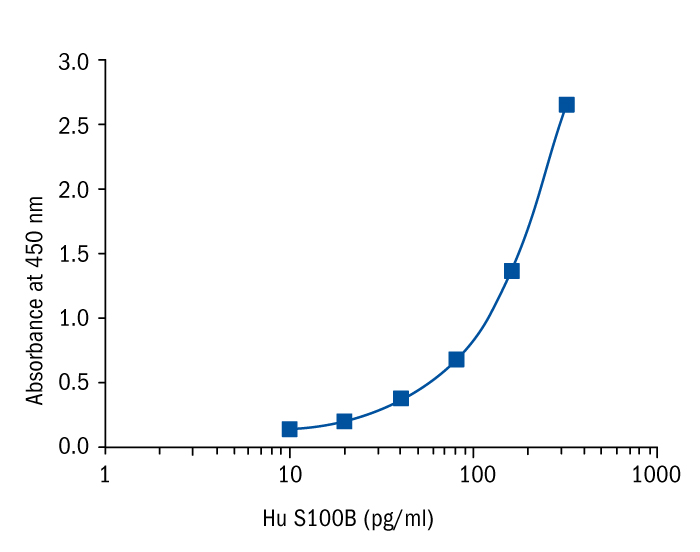
Calibration Curve
|
Calibration range
0.05 – 2 ng/ml
Limit of detection
Analytical Limit of Detection is calculated from the real S100B values in wells and is 15 pg/ml.
Intra-assay (Within-Run, n=6)
CV = 3.8 %
Inter-assay (Run-to-Run, n=3)
CV = 7.7 %
Spiking Recovery
99.3 %
Dilution Linearity
99.0 %
Cross-Reactivity
Bovine, Cat, Goat, Hamster, Pig, Rabbit, Rat
References to this product
- Serarslan Y, Bal R, Altug ME, Kontas T, Melek IM. Caffeic acid phenethyl ester decreases the level of S-100B protein after middle cerebral artery [correction for after] occlusion in rabbits. Pak J Pharm Sci. 2009 Jul;22 (3):313-6
- Kwon BK, Stammers A, Belanger LM, Bernardo A, Chan D, Bishop CM, Slobogean GP, Umedaly H, Giffin M, Street J, Boyd MC, Paquette SJ, Fisher CG, Dvorak MF. Cerebrospinal Fluid Inflammatory Cytokines and Biomarkers of Injury Severity in Acute Human Spinal Cord Injury. J Neurotrauma. 2009 Dec 28;
- Hu S, Dong HL, Li YZ, Luo ZJ, Sun L, Yang QZ, Yang LF, Xiong L. Effects of remote ischemic preconditioning on biochemical markers and neurologic outcomes in patients undergoing elective cervical decompression surgery: a prospective randomized controlled trial. J Neurosurg Anesthesiol. 2010 Jan;22 (1):46-52
- Jesse S, Steinacker P, Cepek L, von Arnim CA, Tumani H, Lehnert S, Kretzschmar HA, Baier M, Otto M. Glial fibrillary acidic protein and protein S-100B: different concentration pattern of glial proteins in cerebrospinal fluid of patients with Alzheimer's disease and Creutzfeldt-Jakob disease. J Alzheimers Dis. 2009 Jul;17 (3):541-51
- Misu T, Takano R, Fujihara K, Takahashi T, Sato S, Itoyama Y. Marked increase in cerebrospinal fluid glial fibrillar acidic protein in neuromyelitis optica: an astrocytic damage marker. J Neurol Neurosurg Psychiatry. 2009 May;80 (5):575-7
- Brouns R, De Vil B, Cras P, De Surgeloose D, Marien P, De Deyn PP. Neurobiochemical Markers of Brain Damage in Cerebrospinal Fluid of Acute Ischemic Stroke Patients. Clin Chem. 2009 Dec 3;
- Hsu AA, Fenton K, Weinstein S, Carpenter J, Dalton H, Bell MJ. Neurological injury markers in children with septic shock. Pediatr Crit Care Med. 2008 May;9 (3):245-51
- Friel LA, Romero R, Edwin S, Nien JK, Gomez R, Chaiworapongsa T, Kusanovic JP, Tolosa JE, Hassan SS, Espinoza J. The calcium binding protein, S100B, is increased in the amniotic fluid of women with intra-amniotic infection/inflammation and preterm labor with intact or ruptured membranes. J Perinat Med. 2007;35 (5):385-93
References to summary
- Zimmer, D.B, Cornwall, E.H., Landar, A. and Song, W.: The S100 Protein Family: History, Function, and Expression. Brain Research Bulletin. 37 (4), 417–429 (1995)
- Kärnell R. et al: S100B Protein, 5-S-Cysteinyldopa and 6-Hydroxy-5-Methoxyindole-2-Carboxylic Acid as Biochemical Markers for Survival Prognosis in Patients with Malignant Melanoma. Melanoma Research 7, 393–399 (1997)
- Jönsson H. et al: S100ı After Coronary Artery Surgery: Release Pattern, Source of Contamination, and Relation to Neuropsychological Outcome. Ann Thorac Surg. 68, 2202–2208 (1999)
- Hauschild A. et al: S100B Protein Detection in Serum Is a Significant Prognostic Factor in Metastatic Melanoma. Oncology 56, 338–344 (1999)
- Donato R: S100: a Multigenic Family of Calcium-Modulated Proteins of the EF-Hand Type with Intracellular and Extracellular Functional Roles. Int J Biochem Cell Biol. 33(7), 637–68 (2001)
- Reynolds M.A. et al: Early Biomarkers of Stroke. Clinical Chemistry 49:10, 1733–1739 (2003)
- Johnsson P et al: Increased S100B in Blood After Cardiac Surgery Is a Powerful Predictor of Late Mortality. Ann Thorac Surg 75, 162–168 (2003)
- Beems T. et al: Serum- and CSF-concentrations of Brain Specific Proteins in Hydrocephalus. Acta Neurochir 145, 37–43 (2003)
- Gazzolo D et al: S100B protein in urine of preterm newborns with ominous outcome. Pediatr Res. 2005 Dec;58(6):1170–4.
- Fernandez-Fernandez MR et al: Proteins of the S100 family regulate the oligomerization of p53 tumor suppressor. Proc Natl Acad Sci USA. 2005 Mar 29; 102(13):4735–40.
- Delgado P et al: Plasma S100B level after acute spontaneous intracerebral hemorrhage. Stroke. 2006 Nov;37(11):2837–9.
- Ralay Ranaivo H et al: Glia as a therapeutic target: selective suppression of human amyloid-beta-induced upregulation of brain proinflammatory cytokine production attenuates neurodegeneration. J Neurosci. 2006 Jan 11;26(2):662–70.
- Sanchez-Juan P et al: CSF tests in the differential diagnosis of Creutzfeldt-Jakob disease. Neurology. 2006 Aug 22;67(4):637–43.
- Steiner J et al: Increased cerebrospinal fluid and serum levels of S100B in first-onset schizophrenia are not related to a degenerative release of glial fibrillar acidic protein, myelin basic protein and neurone-specific enolase from glia or neurones. J Neurol Neurosurg Psychiatry. 2006 Nov;77(11):1284–7.
- Steiner J et al: Evidence for a wide extra-astrocytic distribution of S100B in human brain. BMC Neurosci. 2007 Jan 2;8:2.
Shopping cart
Your cart is empty.