You are here:
Products\Immunoassays\sCD44std Human ELISA:
sCD44std Human ELISA
| Other names: Phagocytic glycoprotein I, Extracellular matrix receptor-III, GP90 lymphocyte homing/adhesion receptor, Hermes antigen, Hyaluronate receptor, Heparan sulfate proteoglycan, Epican, CD44 antigen , Phagocytic glycoprotein I, Extracellular matrix receptor-III, GP90 lymphocyte homing/adhesion receptor, Hermes antigen, Hyaluronate receptor, Heparan sulfate proteoglycan, Epican, CD44 antigen | Product of BioVendor | ||||
| Product: | Size: | ||||
|---|---|---|---|---|---|
| RBMS209/2R (regulatory status: RUO) | 96 wells (1 kit) | ||||
| Files: Datasheet PDF (RUO)MSDS (RUO) | |||||
Product details
Summary
CD44 (85–250 kDa) is a polymorphic glycoprotein. Determination of sCD44std will provide more detailed insight into different pathological modifications during cancer and other diseases.
- brain tumors: CD44 is strongly expressed in high-grade gliomas and weakly expressed in meningiomas, medulloblastomas and normal brain.
- colorectal carcinomas: in human colorectal neoplasia CD44 variant proteins are found on all invasive carcinomas and during carcinoma metastasis. Variants are already expressed at a relatively early stage of colorectal carcinogenesis and tumor progression.
- gastric cancer: tumors from patients suffering from stomach adenocarcinomas express CD44 variants. Adenocarcinomas of the intestinal type are strongly positive for exon v5 and v6, whereas diffuse type adenocarcinomas predominantly express exon v5.
- lung, breast cancer: in malignant tissues there is gross overproduction of alternatively-spliced large molecular variants in all samples, whereas in the control samples only the standard product was routinely detected with occasional minimal quantities of one or two small variants.
- lymphoma: in gastrointestinal lymphoma overexpression of CD44 has been correlated with poor survival and more disseminated disease (6,3). Overexpression of CD44 is also found in several aggressive, but not low-grade, non-Hodgkin´s lymphomas (7) as well as in Hodgkin´s and nodal diffuse lymphomas.
- tonsil, skin cancer: variant CD44 isoform expression can be demonstrated in the plasma membrane of squamous cells of skin and tonsil epithelial and is greatly diminished in malignant squamous epithelial tumors.
- HIV: CD44 is almost completely depleted from the surface of HIV-infected cells.
- inflammatory joint diseases: CD44 expression was decreased in synovial fluid neutrophils from most patients.
Research topic
Autoimmunity, Cell adhesion proteins , Cell surface proteins (sCD), Immune Response, Infection and Inflammation, Oncology
Assay format
Sandwich ELISA, HRP-labelled antibody
Applications
Amniotic fluid, Cell culture supernatant, Plasma, Serum, Urine
Sample requirements
20 µl (1:60 prediluted)
Storage/Shipping
Store kit reagents between 2° and 8°C.
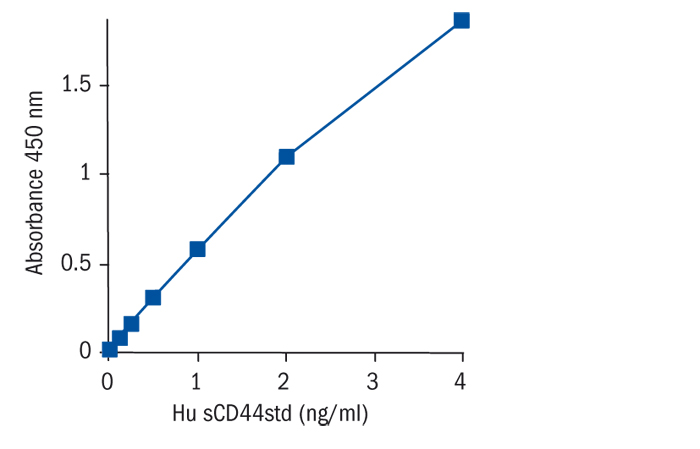
Calibration Curve
|
Calibration range
0.12–4 ng/ml
Limit of detection
0.015 ng/ml
Intra-assay
CV = 4.8 %
Inter-assay
CV = 4.1 %
Spiking Recovery
89 %
Dilution Linearity
94 %
References to summary
- Heider KH, Hofmann M, Hors E, van den Berg F, Ponta H, Herrlich P, Pals ST. A human homologue of the rat metastasis-associated variant of CD44 is expressed in colorectal carcinomas and adenomatous polyps. J Cell Biol. 1993 Jan;120 (1):227-33
- Goldstein LA, Zhou DF, Picker LJ, Minty CN, Bargatze RF, Ding JF, Butcher EC. A human lymphocyte homing receptor, the hermes antigen, is related to cartilage proteoglycan core and link proteins. Cell. 1989 Mar 24;56 (6):1063-72
- Stamenkovic I, Amiot M, Pesando JM, Seed B. A lymphocyte molecule implicated in lymph node homing is a member of the cartilage link protein family. Cell. 1989 Mar 24;56 (6):1057-62
- Koopman G, Heider KH, Horst E, Adolf GR, van den Berg F, Ponta H, Herrlich P, Pals ST. Activated human lymphocytes and aggressive non-Hodgkin's lymphomas express a homologue of the rat metastasis-associated variant of CD44. J Exp Med. 1993 Apr 1;177 (4):897-904
- Heider KH, Dammrich J, Skroch-Angel P, Muller-Hermelink HK, Vollmers HP, Herrlich P, Ponta H. Differential expression of CD44 splice variants in intestinal- and diffuse-type human gastric carcinomas and normal gastric mucosa. Cancer Res. 1993 Sep 15;53 (18):4197-203
- Kuppner MC, Van Meir E, Gauthier T, Hamou MF, de Tribolet N. Differential expression of the CD44 molecule in human brain tumours. Int J Cancer. 1992 Feb 20;50 (4):572-7
- Fujiwara K, Yoshino T, Miyake K, Ohara N, Akagi T. Expression of a lymphocyte adhesion molecule (CD44) in malignant lymphomas: relevance to primary site, histological subtype and clinical stage. Acta Med Okayama. 1993 Jun;47 (3):215-22
- Moller P, Eichelmann A, Mechtersheimer G, Koretz K. Expression of beta 1-integrins, H-CAM (CD44) and LECAM-1 in primary gastro-intestinal B-cell lymphomas as compared to the adhesion receptor profile of the gut-associated lymphoid system, tonsil and peripheral lymph node. Int J Cancer. 1991 Dec 2;49 (6):846-55
- Humbria A, Diaz-Gonzalez F, Campanero MR, Arroyo AG, Laffon A, Gonzalez-Amaro R, Sanchez-Madrid F. Expression of L-selectin, CD43, and CD44 in synovial fluid neutrophils from patients with inflammatory joint diseases. Evidence for a soluble form of L-selectin in synovial fluid. Arthritis Rheum. 1994 Mar;37 (3):342-8
- Guo MM, Hildreth JE. HIV-induced loss of CD44 expression in monocytic cell lines. J Immunol. 1993 Aug 15;151 (4):2225-36
- Joensuu H, Ristamaki R, Klemi PJ, Jalkanen S. Lymphocyte homing receptor (CD44) expression is associated with poor prognosis in gastrointestinal lymphoma. Br J Cancer. 1993 Aug;68 (2):428-32
- Salmi M, Gron-Virta K, Sointu P, Grenman R, Kalimo H, Jalkanen S. Regulated expression of exon v6 containing isoforms of CD44 in man: downregulation during malignant transformation of tumors of squamocellular origin. J Cell Biol. 1993 Jul;122 (2):431-42
- Matsumura Y, Tarin D. Significance of CD44 gene products for cancer diagnosis and disease evaluation. Lancet. 1992 Oct 31;340 (8827):1053-8
- Tolg C, Hofmann M, Herrlich P, Ponta H. Splicing choice from ten variant exons establishes CD44 variability. Nucleic Acids Res. 1993 Mar 11;21 (5):1225-9
- Omary MB, Trowbridge IS, Letarte M, Kagnoff MF, Isacke CM. Structural heterogeneity of human Pgp-1 and its relationship with p85. Immunogenetics. 1988;27 (6):460-4
By research topic:
- Autoimmunity
- Cell adhesion proteins
- Cell surface proteins (sCD)
- Immune Response, Infection and Inflammation
- Oncology
By molecule:
Shopping cart
Your cart is empty.