You are here: Products\Immunoassays\sHLA-G ELISA:

sHLA-G ELISA

Product of BioVendor
Cat. No.: RD194070100R Regulatory status: RUO
Size: 96 wells (1 kit) |
Files: Datasheet PDF (RUO)
Legend: new product new product
discount discount
temporarily out of stock temporarily out of stock
book in advance order in advance

Research topic

Reproduction

Features

  • The total assay time is less than four hours.
  • The kit measures shedded HLA-G1 and HLA-G5.
  • Quality controls are tissue culture based.
  • Components of the kit are ready-to-use (with the exception of Standard Material and Wash Solution).

Storage/Shipping

Store the kit at 2–8°C. Under these conditions, the kit is stable until the expiration date (see label on the box).

Summary

HLA-G differs from the other MHC class I genes by its low polymorphism and alternative splicing that generates seven HLA-G proteins, whose tissue-distribution is restricted to normal fetal and adult tissues that display a tolerogeneic function toward both innate and acquired immune cells. Soluble HLA-G is an immunosuppressive molecule inducing apoptosis of activated CD8(+) T cells and down-modulating CD4(+) T cell proliferation. Recently, using specific ELISA to analyse the presence of sHLA-G molecules in culture supernatants of early embryos obtained by in vitro fertilization (IVF) before transfer, several reports demonstrated that positive embryo implantations occurred with embryo secreting sHLA-G molecules. These breakthrough results indicate that sHLA-G ELISA can be a useful biochemical assay in addition to embryo morphology in embryo selection for transfer in IVF treatment if there are other embryos with the same morphology. Furthermore, monitoring of sHLA-G in amniotic fluid and plasma of pregnant women may have an important prognostic value to recognize pathological situations. Other interesting observations suggest that HLA-G molecules seem to be directly involved in transplant acceptation, and their analysis should be taken into consideration when monitoring transplant-patients status. In addition, soluble HLA-G plasma levels are increased in lyphoproliferative disorders or in patients suffering from malignant melanoma, glioma, breast and ovarian cancer.

Assay format

Sandwich ELISA, HRP-labelled antibody

Sample requirements

50 µl/well

Applications

Amniotic fluid, Cell culture medium, Plasma-Citrate, Plasma-EDTA, Plasma-Heparin, Serum

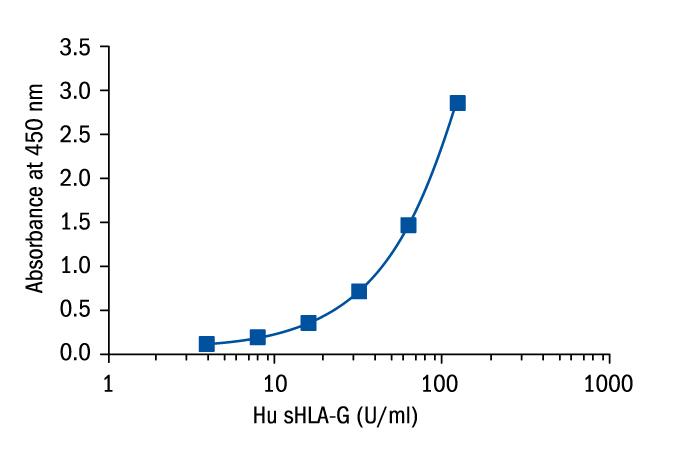
Calibration Curve

Calibration range

1.95 – 125 Units/ml

Limit of detection

Analytical Limit of Detection is calculated from the real sHLA-G values in wells and is 1U/ml

Intra-assay (Within-Run, n=10)

CV = 5.1 %

Inter-assay (Run-to-Run, n=7)

CV = 11.7 %

Cross-Reactivity

Human, Bovine, Cat, Dog, Goat, Monkey, Rabbit, Sheep

References to this product

  • Wiendl H, Mitsdoerffer M, Hofmeister V, Wischhusen J, Bornemann A, Meyermann R, Weiss EH, Melms A, Weller M . A functional role of HLA-G expression in human gliomas: an alternative strategy of immune escape. J Immunol . May 1;168(9):4772-80 (2002)
  • Desai N, Filipovits J, Singh P, Beman M, Goldfarb J . Assessment of soluble HLA-G levels in day 3 human embryo culture media using a new ELISA kit: Is there a relationship to embryo quality, development and implantation potential?. Fertility & Sterility . Vol. 84, Suppl 1 (S281-S282), September 2005
  • Steinborn A, Varkonyi T, Scharf A, Bahlmann F, Klee A, Sohn C . Early detection of decreased soluble HLA-G levels in the maternal circulation predicts the occurrence of preeclampsia and intrauterine growth retardation during further course of pregnancy. Am J Reprod Immunol . Apr;57(4):277-86 (2007)
  • Tahan F, Patiroglu T . Plasma soluble human leukocyte antigen G levels in asthmatic children. Int Arch Allergy Immunol . 141(3):213-6 (2006)
  • Desai N, Filipovits J, Goldfarb J . Secretion of soluble HLA-G by day 3 human embryos associated with higher pregnancy and implantation rates: assay of culture media using a new ELISA kit. Repro Biomed Online . Aug;13(2):272-7 (2006)
  • Coulam CB, Roussev RG . Soluble HLA G Concentrations in Culture Media From In Vitro Fertilized Human Embryos are Predicative of Implantation Potential. Fertility and Sterility . 84(1):S447-S448 (2005)
  • Coulam CB, Roussev RG . Soluble HLA G concentrations in culture media from in vitro fertilized human embryos are predicitive of implantation potential. American Journal of Reproductive Immunology . 53:279-309 (2005)
  • Roussev RG, Suchanek M . Soluble HLA-G in culture medium from individually cultured human embryos is necessary but not essential for successful implantation in IVF/ET. -2005
  • Eidukaite A, Tamosiunas V . Soluble HLA-G in the peritoneal fluid of women with endometriosis. Fertil Steril . May 15 (2007)

References to summary

  • Fujii T., Ishitani A., Geraghty D.E.: A soluble form of the HLA-G antigen is encoded by a messenger ribonucleic acid containing intron 4. J Immunol. 1994; 153: 5516–5524
  • Le Bouteiller P., Mallet V.: HLA-G and pregnancy. Rev Reprod. 1997; 2: 7–13
  • Blaschitz A., Lenfant F., Mallet V., Hartmann M., Bensussan A., Geraghty D.E., Le Bouteiller P., Dohr G.: Endothelial cells in chorionic fetal vessels of first trimester placenta express HLA-G. Eur Immunol. 1997; 27: 3380–3388
  • Chu W., Fant M.E., Geraghty D.E., Hunt J.S.: Soluble HLA-G in human placentas: synthesis in trophoblasts and interferon-gamma-activated macrophages but not placental fibroblasts. Hum Immunol. 1998; 59: 435–442
  • Moreau P., Paul P., Rouas-Freiss N., Kirszenbaum M., Dausset J., Carosella E.D.: Molecular and immunologic aspects of the nonclassical HLA class I antigen HLA-G: evidence for an important role in the maternal tolerance of the fetal allograft. Am J Reprod Immunol. 1998; 40: 136–144
  • Rebman V., Pfeiffer K., Passler M., Ferrone S., Maier S., Weiss E., Grosse-Wilde H.: Detection of soluble HLA-G molecules in plasma and amniotic fluid. Tissue Antigens. 1999; 53: 14–22
  • Hunt J.S., Jadhav L., Chu W., Geraghty D.E., Ober C.: Soluble HLA-G circulates in maternal blood during pregnancy. J Am Obstet Gynecol. 2000; 183: 682–688
  • Emmer P.M., Steegers E.A., van Lierop M.J., Steegers-Theunissen R.P., Loke Y.W., Joosten I.: Amniotic fluid soluble human leukocyte antigen G is markedly decreased in offspring with neural tube defects. Early Hum Dev. 2002; 66: 101–105
  • Fuzzi B., Rizzo R., Criscuoli L., Noci I., Melchiorri L., Scarselli B., Bencini E., Menicucci A., Baricordi O.R.: HLA-G expression in early embryos is a fundamental prerequisite for the obtainment of pregnancy. Eur J Immunol. 2002; 32: 311–315
  • Lila N., Amrein C., Guillemain R., Chevalier P., Latremouille C., Fabiani J.N., Dausset J., Carosella E.D., Carpentier A.: Human leukocyte antigen-G expression after heart transplantation is associated with a reduced incidence of rejection. Circulation. 2002; 105: 1949–1954
  • Carosella E.D., Moreau P., Le Maoult J., Le Discorde M., Dausset J., Rouas-Freiss N.: HLA-G molecules: from maternal-fetal tolerance to tissue acceptance. Adv Immunol. 2003; 81: 199–252
  • LeMaoult J., Le Discorde M., Rouas-Freiss N., Moreau P., Menier C., McCluskey J., Carosella E.D.: Biology and functions of human leukocyte antigen-G in health and sickness. Tissue Antigens. 2003; 62: 273–284
  • Le Bouteiller P., Legrand-Abravanel F., Solier C.: Soluble HLA-G1 at the materno-foetal interface—a review. Placenta. 2003; 24 Suppl A:S10–5
  • Steinborn A., Rebmann V., Scharf A., Sohn C., Grosse-Wilde H.: Placental abruption is associated with decreased maternal plasma levels of soluble HLA-G. J Clin Immunol. 2003; 23: 307–314
  • Le Bouteiller P., Pizzato N., Barakonyi A., Solier C.: HLA-G, pre-eclampsia, immunity and vascular events. J Reprod Immunol. 2003; 59: 219–234
  • Creput C., Durrbach A., Menier C., Guettier C., Samuel D., Dausset J., Charpentier B., Carosella E.D., Rouas-Freiss N.: Human leukocyte antigen-G (HLA-G) expression in biliary epithelial cells is associated with allograft acceptance in liver-kidney transplantation. J Hepatol. 2003; 39: 587–594
  • Sebti Y., Le Friec G., Pangault C., Gros F., Drenou B., Guilloux V., Bernard M., Lamy T., Fauchet R., Amiot L.: Soluble HLA-G molecules are increased in lymphoproliferative disorders. Hum Immunol. 2003; 64: 1093–1101
  • Rebmann V., Regel J., Stolke D., Grosse-Wilde H.: Secretion of sHLA-G molecules in malignancies. Semin Cancer Biol. 2003; 13: 371–377 sHLA-G ELISA (page 13 of 16) VERSION: 33 120607 15
  • Sher G., Keskintepe L., Nouriani M., Roussev R., Batzofin J.: Expression of sHLA-G in supernatants of individually cultured 46-h embryos: a potentially valuable indicator of 'embryo competency and IVF outcome. Reprod Biomed Online. 2004; 9: 74–78
  • Noci I., Fuzzi B., Rizzo R., Melchiorri L., Criscuoli L., Dabizzi S., Biagiotti R., Pellegrini S., Menicucci A., Baricordi O.R.: Embryonic soluble HLA-G as a marker of developmental potential in embryos. Hum Reprod. 2005; 20: 138–146
  • Noci I., Fuzzi B., Rizzo R., Melchiorri L., Criscuoli L., Dabizzi S., Biagiotti R., Pellegrini S., Menicucci A., Baricordi O.R.: Embryonic soluble HLA-G as a marker of developmental potential in embryos. Hum Reprod. 2005; 20: 138–146
  • Yie S.M., Balakier H., Motamedi G., Librach C.L.: Secretion of human leukocyte antigen-G by human embryos is associated with a higher in vitro fertilization pregnancy rate. Fertil Steril. 2005; 83: 30–36
  • Rebman V., Lemaoult J., Rouas-Friess N., Carosella E.D., Grosse-Wilde H.: Report of the Wet Workshop for Quantification of Soluble HLA-G in Essen, 2004. Hum Immunol. 2005; 66: 853–863
  • Le Rond S., Azema C., Krawice-Radanne I., Durrbach A., Guettier C., Carosella E.D., Rouas-Freiss N.: Evidence to support the role of HLA-G5 in allograft acceptance through induction of immunosuppressive/ regulatory T cells. J Immunol. 2006; 176: 3266–3276
  • Gros F., Sebti Y., de Guibert S., Branger B., Bernard M., Fauchet R., Amiot L.: Soluble HLA-G molecules increase during acute leukemia, especially in subtypes affecting monocytic and lymphoid lineages. Neoplasia. 2006; 8: 223–230
  • Luque J., Torres M.I., Aumente M.D., Marin J., Garcia-Jurado G., Gonzalez R., Pascual D., Guerra N., Lopez-Rubio F., Alvarez-Lopez M.R., Arizon J.M., Pena J.: Soluble HLA-G in heart transplantation: their relationship to rejection episodes and immunosuppressive therapy. Hum Immunol. 2006; 67: 257–263


Shopping cart

Your cart is empty.