Type
Sandwich ELISA, Biotin-labelled antibody
Applications
Serum, Plasma-EDTA, Plasma-Heparin, Plasma-Citrate, Urine
Sample Requirements
10 µl/well
Shipping
At ambient temperature. Upon receipt, store the product at the temperature recommended below.
Storage/Expiration
Store the complete kit at 2–8°C. Under these conditions, the kit is stable until the expiration date (see label on the box).
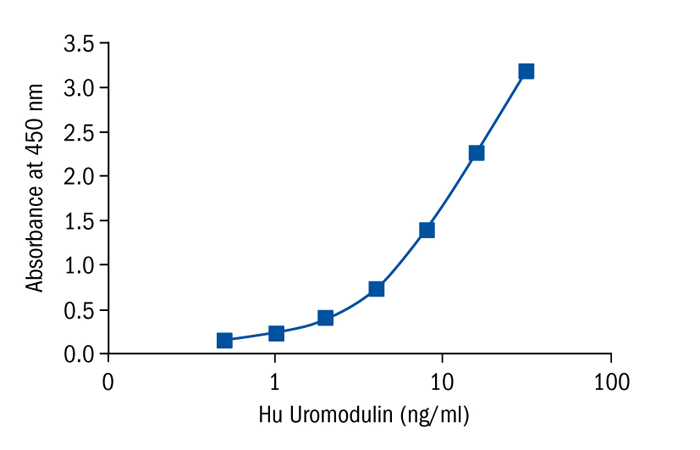
Calibration Curve
Calibration Range
0.5–32 ng/ml
Limit of Detection
0.12 ng/ml
Intra-assay (Within-Run)
n = 8; CV = 2.0%
Inter-assay (Run-to-Run)
n = 6; CV = 6.4%
Spiking Recovery
95,70%
Dilution Linearity
99,90%
Crossreactivity
- bovine Non-detectable
- cat Non-detectable
- dog Non-detectable
- goat Non-detectable
- hamster Non-detectable
- horse Non-detectable
- mouse Non-detectable
- pig Non-detectable
- rabbit Non-detectable
- rat Non-detectable
- sheep Non-detectable
- chicken Not tested
- monkey Yes
- human Yes
Note
The kits are CE-IVD certified and intended for professional use.
Features
- European Union: for in vitro diagnostic use
- Rest of the world: for research use only!
- The total assay time is less than 3.5 hours
- The kit measures uromodulin in serum, plasma (EDTA, citrate, heparin) and urine
- Assay format is 96 wells
- Standard is native protein based
- Quality Controls are human serum based
- Components of the kit are provided ready to use, concentrated or lyophilized
Research topic
Renal disease
Summary
Uromodulin (Tamm-Horsfall protein, UMOD) is approx. 85-kDa glycoprotein that is produced in the thick ascending limb of Henle´s loop and early distal convoluted tubules of the nephron. It is a transmembrane protein, which is secreted into the urine through proteolytic cleavage of the glycosylphosphatidylinositol (GPI) anchor. It belongs to the GPI family. Healthy individuals excrete tens of miligrams of uromodulin per day, making in the most abundant protein in the urine. Uromodulin modulates cell adhesion and signal transduction by interacting with cytokines and it inhibits the aggregation of calcium crystals. By reducing calcium oxalate precipitation, uromodulin plays a protective role with respect to renal stone formation as demonstrated by recent studies on THP- deficient mice prone to nephrolithiasis. THP acts as a host defense factor against urinary tract infections induced by uropathogens such as Esherichia coli, Staphylococcus saphrophyticus, Proteus mirabilis and Klebsiela pneumonie. Uromodulin binds to type 1 fimbriae of Escherichia coli and thereby blocks colonization of urothelial cells. Tamm-Horsfall protein interacts with other molecules and cells including IL-1, IL-2, TNF, IgG, neuthrophils, lymphocytes and monocytes. Binding of uromodulin to neutrophils induces synthesis of IL-8, provokes the respiratory burst and degranulation and stimulates chemotaxis and phagocytosis. Recently, genome-wide association studies identified uromodulin as a risk factor for chronic kidney disease and hypertension. Mutations in the Uromodulin gene are associated with three autosomal dominant tubulo-interstitial nephropathies such as familial juvenile hyperuricemic nephropathy (FJHN), medullary cystic kidney disease (MCKD2) and glomerulocystic kidney disease (GCKD). These disorders are characterized by juvenile onset of hyperuricemia, gout and progressive renal failure.
Find documents for the lot
Example Instructions for Use (RUO)
Example Instructions for Use (RUO)
Safety Information (RUO)
MSDS (RUO)
MSDS (RUO)
Product Brochure
CE IVD Assays
Other Documents
Declaration of Conformity