Type
Recombinant protein
Description
Total 291AA, 33,5 kDa (computed). The AA sequence (14–291) is identical to Swiss-Prot-P25311 (AA18–295 mature Zinc-Alfa-2-Glycoprotein). THIRTEEN extra amino acid were fused with N-terminus.
Amino Acid Sequence
PGDYKDDDDKPAGQENQDGRYSLTYIYTGLSKHVEDVPAFQALGSLNDLQFFRYNSKDRKSQPMGLWRQVEGMEDWKQDSQLQKAREDIFMETLKDIVEYYNDSNGSHVLQGRFGCEIENNRSSGAFWKYYYDGKDYIEFNKEIPAWVPFDPAAQITKQKWEAEPVYVQRAKAYLEEECPATLRKYLKYSKNILDRQDPPSVVVTSHQAPGEKKKLKCLAYDFYPGKIDVHWTRAGEVQEPELRGDVLHNGNGTYQSWVVVAVPPQDTAPYSCHVQHSSLAQPLVVPWEAS
Source
HEK293
Purity
˃ 90 % by SDS-PAGE
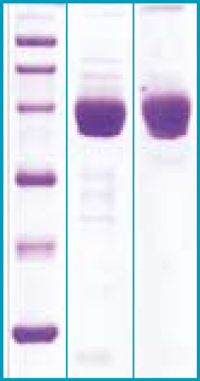
SDS-PAGE Gel
12% SDS-PAGE separation of Human ZA2G
1. M.W. marker – 14, 21, 31, 45, 66, 97 kDa
2. reduced and heated sample, 10μg/lane
3. non-reduced and non-heated sample, 10μg/lane
Endotoxin
< 1.0 EU/µg
Formulation
Filtered (0,4 μm) and lyophilized in 0.5 mg/mL in 20mM TRIS, 50mM NaCl, pH 7.5
Reconstitution
Add deionized water to prepare a working stock solution of 0.5 mg/mL and let the lyophilized pellet dissolve completely.
Applications
Western blotting, ELISA
Shipping
At ambient temperature. Upon receipt, store the product at the temperature recommended below.
Storage/Expiration
Store lyophilized protein at -80°C. Lyophilized protein remains stable until the expiry date when stored at -80°C. Aliquot reconstituted protein to avoid repeated freezing/thawing cycles and store at -80°C for long term storage. Reconstituted protein can be stored at 4°C for a week.
Quality Control Test
BCA to determine quantity of the protein.
SDS PAGE to determine purity of the protein.
Endotoxin level determination.
Note
This product is intended for research use only.
Research topic
Energy metabolism and body weight regulation, Oncology
Summary
Zinc-alpha-2-glycoprotein (ZAG) is found in body fluids such as serum, sweat, and seminal and breast cyst fluids. It is identical in amino acid sequence to tumor-derived lipid mobilizing factor (LMF), a protein associated with the dramatic loss of adipose body stores in cancer cachexia, and has been shown to stimulate lipolysis by adipocytes in vivo and in vitro. A role for ZAG has been proposed in the regulation of body weight, and age-dependent changes in genetically influenced obesity, and also it regulates melanin production by normal and malignant melanocytes. It has also recently been classified as a novel adipokine in that it is produced by both white and brown fat adipocytes and may act in a local autocrine fashion in the reduction of adiposity in cachexia. Controlling ZAG/LMF's activity could be life-saving in the management of certain cancers and other cachexia-inducing conditions, and its possible normal role in body fat store homeostasis is deserving of understanding in its own right. ZAG exhibits a class I major histocompatibility complex (MHC) fold but is a soluble protein rather than being anchored to plasma membranes and does not associate with alpha-2-microglobulin in humans. Like antigen-presenting MHC class I proteins, ZAG has an open apical groove, and X-ray crystallography of human-derived ZAG revealed an unidentifiable electron density in a similar position to that occupied by antigenic peptides in classical MHC proteins and glycolipids in isoforms of CD1. This presumptive ligand is not a peptide, and the groove is too small to hold a glycolipid such as is presented by CD1 isoforms. By analogy with all other MHC class I-related proteins that have an open apical groove [some do not ], occupancy by a ligand is probably crucial to ZAG's biological function. Despite all of the structural and biochemical evidence that ZAG binds a ligand, none has so far been found by extraction from protein isolated from biological fluids. This difficulty could be because the ligand is labile, heterogeneous, or readily lost during purification procedures. Knowing more about how ZAG interacts with the compounds it has been found to bind, both natural and artificial, will inform searches for the elusive ligand(s) and its/their role in ZAG's signaling function.