You are here: Products\Immunoassays\Cystatin C Human ELISA:

Cystatin C Human ELISA

Product of BioVendor
Other names: Post G-globulin, CST 3
Cat. No.: RD191009100 Regulatory status: RUO
Size: 96 wells (1 kit) |
Cat. No.: RD191009100 Regulatory status: IVD CE
Size: 96 wells (1 kit) |
Files: Datasheet PDF (RUO) Datasheet PDF (IVD CE) MSDS (RUO) MSDS (IVD CE)
Legend: new product new product
discount discount
temporarily out of stock temporarily out of stock
book in advance order in advance

Research topic

Renal disease

Features

  • The total assay time is less than 2 hours.
  • The kit measures total serum Cystatin C.
  • Components of the kit are provided ready-to-use and concentrated.

Storage/Shipping

Store the kit at 2–8°C. Under these conditions, the kit is stable until the expiration date (see label on the box).

Summary

Cystatin C is a non-glycosilated basic single-chain protein consisting of 120 amino acids with a molecular weight of 13.36 kDa and is characterized by two disulfide bonds in the carboxy-terminal region. It belongs to the cystatins superfamilly which inactivates lysosomal cysteine proteinases, e.g. cathepsin B, H,.K, L and S. Imbalance between Cystatin C and cysteine proteinases is associated with inflammation, renal failure, cancer, Alzheimer's di­sease, multiple sclerosis and hereditary Cystatin C amyloid angiopathy. Its increased level has been found in patients with autoimune diseases, with colorectal tumors and in patients on dyalisis. Serum Cystatin C seems to be better marker of glomerular filtration rate than creatinine. On the other hand, low concentration of Cystatin C presents a risk factor for secondary cardiovascular events.

Assay format

Sandwich ELISA, HRP-labelled antibody

Sample requirements

10 µl/well

Applications

Cell culture medium, Cerebrospinal fluid, Plasma-Citrate, Plasma-EDTA, Plasma-Heparin, Serum

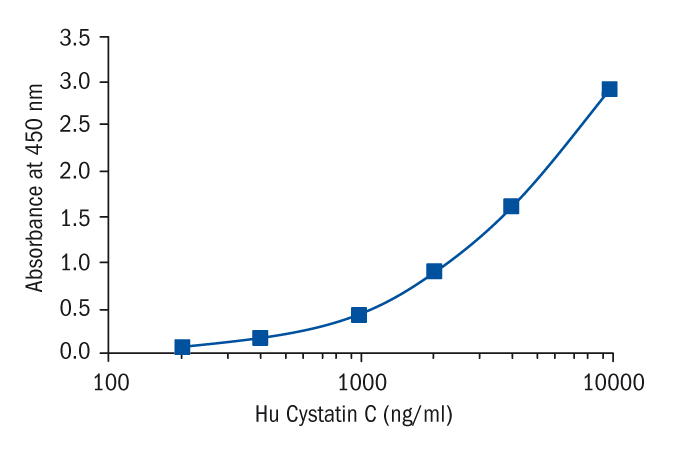
Calibration Curve

Calibration range

200 – 10 000 ng/ml

Limit of detection

Analytical Limit of Detection (LOD) is calculated from the real Cystatin C values in wells and is 0.2 ng/ml.

Limit of quantification

Assay Sensitivity (LOQ) takes the dilution of samples into consideration and is calculated according to the formula: Assay Sensitivity = Analytical Limit of Detection x sample dilution = 0.2 ng/ml x 400 = 80 ng/ml.

Intra-assay (Within-Run, n=8)

CV = 7.3 %

Inter-assay (Run-to-Run, n=6)

CV = 5.5 %

Spiking Recovery

90.8 %

Dilution Linearity

99.5 %

Cross-Reactivity

Human, Cat, Dog

References to this product

  • Yang X, Wang H, Wang Z, Dong M . Alteration and significance of serum cardiac troponin I and cystatin C in preeclampsia. Clin Chim Acta . Dec;374(1-2):168-9 (2006)
  • Stejskal D, Vavrouskova J, Mares J, Urbanek K . Applications of new laboratory marker assays in neurological diagnoses - A pilot study. Biomed Pap Med Fac Univ Palacky Olomouc Czech Repub . Dec;149(2):265-6 (2005)
  • Taleb S, Cancello R, Clement K, Lacasa D . Cathepsin S promotes human preadipocyte differentiation: possible involvement of fibronectin degradation. Endocrinology . Oct;147(10):4950-9 (2006)
  • Taleb S, Lacasa D, Bastard JP, Poitou C, Cancello R, Pelloux V, Viguerie N, Benis A, Zucker JD, Bouillot JL, Coussieu C, Basdevant A, Langin D, Clement K . Cathepsin S, a novel biomarker of adiposity: relevance to atherogenesis. FASEB J . Sep;19(11):1540-2 (2005)
  • Straface E, Matarrese P, Gambardella L, Vona R, Sgadari A, Silveri MC, Malorni W . Oxidative imbalance and cathepsin D changes as peripheral blood biomarkers of Alzheimer disease: a pilot study. FEBS Lett . May 23;579(13):2759-66 (2005)
  • Liu XD, Zeng BF, Xu JG, Zhu HB, Xia QC . Proteomic analysis of the cerebrospinal fluid of patients with lumbar disk herniation. Proteomics . Feb;6(3):1019-28 (2006)
  • Barrientos LG, Rollin PE . Release of cellular proteases into the acidic extracellular milieu exacerbates Ebola virus-induced cell damage. Virology . Sep 15 (2006)
  • Taleb S, Cancello R, Poitou C, Rouault C, Sellam P, Levy P, Bouillot JL, Coussieu C, Basdevant A, Guerre-Millo M, Lacasa D, Clement K . Weight loss reduces adipose tissue cathepsin S and its circulating levels in morbidly obese women. J Clin Endocrinol Metab . Mar;91(3):1042-7 (2006)

References to summary

  • Lindahl P., Abrahamson M., Bjork I.: Interaction of recombinant human cystatin C with the cysteine proteinases papain and actinidin. Biochem J 1992; 281: 49–55
  • Ekiel I. and Abrahamson M.: Folding-related dimerization of human cystatin C. J Biol Chem 1996; 271: 1314–1321
  • Ekiel I., Abrahamson M., Fulton D.B., Lindahl P., Storer A.C., Levadoux W., Lafrance M., Labelle S., Pomerleau Y., Groleau D., LeSauteur L., Gehring K.: NMR structural studies of human cystatin C dimmers and monomers. J Mol Biol 1997; 271: 266–277
  • Tian S., Kusano E., Ohara T., Tabei K., Itoh Y., Kawai T., Asano Y.: Cystatin C measurement and its practical use in patients with various renal diseases. Clin Nephrol 1997; 48: 104–108
  • Walker L.C.: Animal models of cerebral beta-amyloid angiopathy. Brain Res Rev 1997; 25: 70–84
  • Lerner U.H., Johansson L., Ranjso M., Rosenquist J.B., Reinholt F.P., Grubb A.: Cystatin C, an inhibitor of bone resorption produced by osteoblasts. Acta Physiol Scand 1997; 161: 81–92
  • Bokenkamp A., Domanetzki M., Zinck R., Schumann G., Byrd D., Brodehl J.: Cystatin C – a new marker of glomerular filtration rate in children independent of age and height. Pediatrics 1998; 101: 875–881
  • Shi G.P., Sukhova G.K., Grubb A., Ducharme A., Rhode L.H., Lee R.T., Ridker P.M., Libby P., Chapman H.A.: Cystatin C deficiency in human atherosclerosis and aortic aneurysms. J Clin Invest 1999; 104: 1191–1197
  • Risch L., Blumberg A., Huber A.: Rapid and accurate assessment of glomerular filtration rate in patients with renal transplants using serum cystatin C. Nephrol Dial Transplant 1999; 14: 1991–1996
  • Le Bricon T., Thervet E., Benlakehal M., Bousquet B., Legendre C., Erlich D.: Changes in plasma cystatin C after renal transplantation and acute rejection in adults. Clin Chem 1999; 45: 2243–2249
  • Cimerman N., Brguljan P.M., Krasovec M., Suskovic S., Kos J.: Twenty-four hour variations of cystatin C and total cysteine proteinase inhibitory activity in sera from healthy subjects. Clin Chim Acta 2000; 291: 89–95
  • Stabuc B., Vrhovec L., Stabuc-Silih M., Cizej T.E.: Improved prediction of decreased creatinine clearance by serum cystatin C: use in cancer patients before and during chemotherapy. Clin Chem 2000; 46: 193–197
  • Mangge H., Liebmann P., Tanil H., Herrmann J., Wagner C., Gallistl S., Schauenstein K., Erwa W.: Cystatin C, an early indicator for incipient renal disease in rheumatoid arthritis. Clin Chim Acta 2000; 300: 195–202
  • Takeuchi M., Fukuda Y., Nakano I., Katano Y., Hayakawa T.: Evaluation of serum cystatin C concentrations in patients with chronic liver disease. Eur J Gastroenterol Hepatol 2001; 13: 951–955
  • Bokenkamp A., Dieterich C., Dressler F., Muhlhaus K., Gembruch U., Bald R., Kirschstein M.: Fetal serum concentrations of cystatin C and beta2-microglobulin as predictors of postnatal kidney function. Am J Obstet Gynecol 2001; 185: 468–475
  • Deng A., Irizarry M.C., Nitsch R.M., Growdon J.H., Rebeck G.W.: Elevation of cystatin C in susceptible neurons in Alzheimer's di­sease. Am J Pathol 2001; 159: 1061–1068
  • Demirtas S., Bozbas A., Akbay A., Yavuz Y., Karaca L.: Diagnostics value of cystatin C for evaluation of hepatorenal syndrome. Clin Chim Acta 2001; 311: 81–89
  • Lindholt J.S., Erlandsen E.J., Henneberg E.W.: Cystatin C deficiency is associated with the progression of small abdominal aortic aneurysms. Br J Surg 2001; 88: 1472–1475
  • Tan G.D., Lewis A.V., JamesT.J., Altmann P., Taylor R.P., Levy J.C.: Clinical usefulness of cystatin C for the estimation of glomerular filtration rate in type 1 diabetes: reproducibility and accuracy compared with standard measures and iohexol clearance. Diabetes Care 2002; 25: 2004–2009
  • Mussap M., Dalla Vestra M., Fioretto P., Saller A., Varagnolo M., Nosadini R., Plebani M.: Cystatin C is a more sensitive marker than creatinine for the estimation of GFR in type 2 diabetic patients. Kidney Int 2002; 61: 1453–1461
  • Kazama J.J., Kutsuwada K., Ataka K., Maruyama H., Gejyo F.: Serum cystatin C reliably detects renal dysfunction in patients with various renal diseases. Nephron 2002; 91: 13–20
  • Uchida K. and Gotoh A.: Measurement of cystatin-C and creatinine in urine. Clin Chim Acta 2002; 323: 121–128 Human Cystatin C ELISA (page 24 of 28) VERSION 33 160707 04
  • Dharnidharka V.R., Kwon C., Stevens G.: Serum cystatin C is superior to serum creatinine as a marker of kidney function: a meta-analysis. Am J Kidney Dis 2002; 40: 221–226
  • Mares J., Stejskal D., Vavrouskova J., Urbanek K., Herzig R., Hlustik P.: Use of cystatin C determination in clinical diagnostics. Biomed Papers 2003; 147: 177–180
  • Mojiminiyi O.A. and Abdella N.: Evaluation of cystatin C and beta-2 microglobulin as markers of renal function in patients with type 2 diabetes mellitus. J Diabetes Complications 2003; 17: 160–168
  • Benussi L., Ghidoni R., Steinhoff T., Alberici A., Villa A., Mazzoli F., Nicosia F., Barbiero L., Broglio L., Feudatari E., Signorini S., Finckh U., Nitsch R.M., Binetti G.: Alzheimer disease-associated cystatin C variant undergoes impaired secretion. Neurobiol Dis 2003; 13: 15–21
  • Perlemoine C., Beauvieux M.C., Rigalleau V., Baillet L., Barthes N., Derache P., Gin H.: Interest of cystatin C in screening diabetic patients for early impairment of renal function. Metabolism 2003; 52: 1258–1264
  • Wiesli P., Schwegler B., Spinas G.A., Schmid C.: Serum cystatin C is sensitive to small changes in thyroid function. Clin Chim Acta 2003; 338: 87–90
  • Watanabe S., Okura T., Liu J., Miyoshi K., Fukuoka T., Hiwada K., Higaki J.: Serum cystatin C level is a marker of end-organ damage in patients with essential hypertension. Hypertens Res 2003; 26: 895–899
  • Mussap M. and Plebani M.: Biochemistry and Clinical Role of Human Cystatin C. Crit Rev Clin Lab Sci 2004; 41: 467–550
  • Johnston N., Jernberg T., Lindahl B., Lindback J., Stridsberg M., Larsson A., Venge P., Wallentin L.: Biochemical indicators of cardiac and renal function in a healthy elderly population. Clin Biochem 2004; 37: 210–216
  • Weiner D.E., Tighiouart H., Stark P.C., Amin M.G., MacLeod B., Griffith J.L., Salem D.N., Levevy A.S., Sarnak M.J.: Kidney disease as a risk factor for recurrent cardiovascular disease and mortatlity. Am J Kidney Dis 2004; 44: 198–206
  • Jernberg T., Lindhal B., James S., Larsson A., Hansson L.O., Wallentin L.: Cystatin C: a novel predictor of outcome in suspected or confirmed non-ST-elevation acute coronary syndrome. Circulation 2004; 110: 2342–2348
  • Koenig W., Twardella D., Brenner H., Rothenbacher D.: Plasma Concentrations of Cystatin C in Patients with Coronary Heart Disease and Risk for Secondary Cardiovascular Events: More Than Simply a Marker of Glomerular Filtration Rate. Clin Chem 2004
  • Shlipak M.G., Sarnak MJ, Katz R, Fried L, Seliger S, Newman A, Siscovick D, Stehman-Breen C.: Cystatin-C and mortality in elderly persons with heart failure. J Am Coll Cardiol 2005; 45: 268–271
  • Artunc F.H., Fischer I.U., Risler T., Erley C.M.: Improved estimation of GFR by serum cystatin C in patients undergoing cardiac catheterization. Int J Cardiol 2005; 102: 173–178
  • Luc G., Bard J.M., Lesueur C., Arveiler D., Evans A., Amouyel P., Ferrieres J., Juhan-Vague I., Fruchart J.C., Ducimetiere P.: Plasma cystatin-C and development of coronary heart disease: The PRIME Study. Atherosclerosis 2005
  • Noto D., Cefalu A.B., Barbagallo C.M., Pace A., Rizzo M., Marino G., Caldarella R., Castello A., Pernice V., Notarbartolo A., Averna M.R.: Cystatin C levels are decreased in acute myocardial infarction; Effect of cystatin C G73A gene polymorphism on plasma levels. Int J Cardiol 2005; 101: 213–217
  • Conti M., Zater M., Lallali K., Durrbach A., Moutereau S., Manivet P., Eschwege P., Loric S.: Absence of circadian variations in urine cystatin C allows its use on urinary samples. Clin Chem 2005; 51: 272–273
  • Seliger S.L., Longstreth W.T. Jr., Kratz R., Manolio T., Fried L.F., Shlipak M., Stehman-Breen C.O., Newman A., Sarnak M., Gillen D.L., Bleyer A., Siscovick D.S.: Cystatin C and subclinical brain infarction. J Am Soc Nephrol. 2005; 16: 3721–3727
  • Fried L.F., Kratz R., Sarnak M.J., Shlipak M.G., Chaves P.H., Jenny N.S., Stehman-Breen C., Gillen D., Bleyer A.J., Hirsch C., Siscovick D., Newman A.B.: Kidney function as a predictor of noncardiovascular mortality. J Am Soc Nephrol. 2005; 16: 3728–3735
  • Shlipak M.G., Wassel Fyr C.L., Chertow G.M., Harris T.B., Kritchevsky S.B., Tylavsky F.A., Satterfield S., Cummings S.R., Newman A.B., Fried L.F.: Cystatin C and mortality risk in the elderly: the health, aging, and body composition study. J Am Soc Nephrol. 2006; 17: 254–261
  • Kato T., Heike T., Okawa K., Haruyama M., Shiraishi K., Yoshimoto M., Nagato M., Shibata M., Kumada T., Yamanaka Y., Hatorri H., Nakahata T.: A neurosphere-derived factor, cystatin C, supports differentiation of ES cells into neural stem cells. Proc Natl Acad Sci U S A. 2006;103: 6019–6024 Human Cystatin C ELISA (page 25 of 28) VERSION 33 160707 04
  • Conti M., Moutereau S., Zater M., Lallali K., Durrbach A., Manivet P., Eschwege P., Loric S.: Urinary cystatin C as a specific marker of tubular dysfunction. Clin Chem Lab Med. 2006; 44: 288–291
  • Macisaac R.J., Tsalamandris C., Thomas M.C., Premaratne E., Panagiotopoulos S., Smith T.J., Poon A., Jenkins M.A., Ratnaike S.I., Power D.A. Jerums G.: Estimating glomerular filtration rate in diabetes: a comparison of cystatin-C- and creatinine-based methods. Diabetologia. 2006; 49: 1686–1689
  • Nakashima I., Fujihara K., Fujinoki M., Kawamura T., Nishimura T., Nakamura M., Itoyama Y.: Alteration of cystatin C in the cerebrospinal fluid of multiple sclerosis. Ann Neurol. 2006
  • Fried L.F., Biggs M.L., Shlipak M.G., Seliger S., Kestenbaum B., Stehman-Breen C., Sarnak M., Siscovick D., Harris T., Cauley J., Newman A.B., Robbins J.: Association of kidney function with incident hip fracture in older adults. J Am Soc Nephrol. 2007; 18: 282–286


Shopping cart

Your cart is empty.