United States set
language
Menu Shopping cart $0 Search
Manufactured by BioVendor

Leptin Human ELISA, Clinical Range

Leptin Human ELISA, Clinical Range
  • Regulatory status:RUO
  • Type:Sandwich ELISA, HRP-labelled antibody
  • Other names:Obesity factor, Obese protein, LEP, OB, OBS
  • Species:Human
United States orders are shipped from our US branch, BioVendor, LLC
Cat. No. Size Price


RD191001100 96 wells (1 kit) $375
PubMed Product Details
Technical Data

Type

Sandwich ELISA, HRP-labelled antibody

Applications

Serum, Plasma-EDTA, Plasma-Heparin, Plasma-Citrate

Sample Requirements

35 µl/well

Shipping

At ambient temperature. Upon receipt, store the product at the temperature recommended below.

Storage/Expiration

Store the kit at 2–8°C. Under these conditions, the kit is stable until the expiration date (see label on the box).

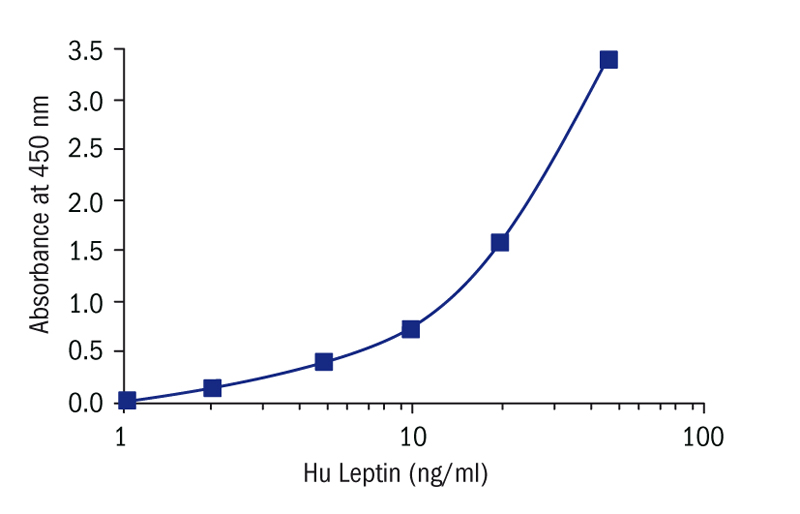
Calibration Curve

Calibration Range

1-50 ng/ml

Limit of Detection

0.2 ng/ml

Intra-assay (Within-Run)

n=8, CV = 5.9%

Inter-assay (Run-to-Run)

n=6, CV = 5.6%

Spiking Recovery

92.1%

Dilution Linearity

100.8%

Crossreactivity

  • bovine Non-detectable
  • cat Non-detectable
  • dog Non-detectable
  • goat Non-detectable
  • hamster Non-detectable
  • horse Non-detectable
  • monkey Non-detectable
  • mouse Non-detectable
  • pig Non-detectable
  • rabbit Non-detectable
  • rat Non-detectable
  • sheep Non-detectable
  • chicken Not tested
  • human Yes

Note

The kits are CE-IVD certified and intended for professional use.

More about Leptin on BioVendor Scientific Blog

Summary

Features

  • European Union: for in vitro diagnostic use
  • Rest of the world: for research use only!
  • The total assay time is less than 2.5 hours
  • The kit measures total leptin
  • Assay format is 96 wells
  • Quality Controls are human serum based
  • Standards are recombinant protein based
  • Components of the kit are provided ready to use, concentrated or lyophilized

Research topic

Diabetology - Other Relevant Products, Energy metabolism and body weight regulation, Reproduction

Summary

Leptin, the product of the ob (obese) gene, is a single-chain 16 kDa protein consisting of 146
amino acid residues. Leptin is produced mainly in the adipose tissue, and is considered to play
an important role in appetite control, fat metabolism and body weight regulation. It targets the
central nervous system, particularly hypothalamus, affecting food intake. The primary effect of
leptin appears to be mediated by leptin receptors expressed mainly in the hypothalamus. In
humans, leptin levels correlate with body mass index (BMI) and percentage body fat, and are
elevated even in obese individuals. Leptin has a dual action; it decreases the appetite and
increases energy consumption, causing more fat to be burned. Leptin is secreted in circadian
fashion with nocturnal rise in both lean and obese patients.

Mutations of the ob gene resulting in leptin deficiency are the cause of obesity in the ob/ob
mice. Endogeneous leptin can normalize their body weight. In contrast, high levels of leptin in
obese human subjects point to an insensitivity to endogeneous leptin.
Other factors in addition to the amount of body fat appear to regulate leptin action: insulin,
glucocorticoids, catecholamines and sex hormones. Studies have shown that leptin may be
linked to reproductive function.

Product References (126)

References

  • .
  • .
  • .
  • .
  • .
  • .
  • .
  • .
  • .
  • .
  • .
  • .
  • .
  • .
  • .
  • .
  • .
  • .
  • .
  • .
  • .
  • .
  • .
  • .
  • .
  • .
  • .
  • .
  • .
  • .
  • .
  • .
  • .
  • .
  • .
  • .
  • .
  • .
  • .
  • .
  • .
  • .
  • .
  • .
  • .
  • .
  • .
  • .
  • .
  • .
  • .
  • .
  • .
  • .
  • .
  • .
  • .
  • .
  • .
  • .
  • .
  • .
  • .
  • .
  • .
  • .
  • .
  • .
  • .
  • .
  • .
  • .
  • .
  • .
  • .
  • .
  • .
  • .
  • .
  • .
  • .
  • .
  • .
  • .
  • .
  • .
  • .
  • .
  • .
  • .
  • .
  • .
  • .
  • .
  • .
  • .
  • .
  • .
  • .
  • .
  • .
  • .
  • .
  • .
  • .
  • .
  • .
  • .
  • .
  • .
  • .
  • .
  • .
  • .
  • .
  • .
  • .
  • .
  • .
  • .
  • .
  • .
  • .
  • .
  • .
  • .
Summary References (20)

References to Leptin

  • Auwerx J, Staels B. Leptin (Review article). The Lancet . 13, 737 (1998);
  • Blum WF, Englaro P, Hanitsch S, Juul A, Hertel NT, Muller J, Skakkebaek NE, Heiman ML, Birkett M, Attanasio AM, Kiess W, Rascher W. Plasma leptin levels in healthy children and adolescents: dependence on body mass index, body fat mass, gender, pubertal stage, and testosterone. J Clin Endocrinol Metab. 1997 Sep;82 (9):2904-10
  • Chehab FF, Mounzih K, Lu R, Lim ME. Early onset of reproductive function in normal female mice treated with leptin. Science. 1997 Jan 3;275 (5296):88-90
  • Clement K, Vaisse C, Lahlou N, Cabrol S, Pelloux V, Cassuto D, Gourmelen M, Dina C, Chambaz J, Lacorte JM, Basdevant A, Bougneres P, Lebouc Y, Froguel P, Guy-Grand B. A mutation in the human leptin receptor gene causes obesity and pituitary dysfunction. Nature. 1998 Mar 26;392 (6674):398-401
  • Cohen B, Novick D, Rubinstein M. Modulation of insulin activities by leptin. Science. 1996 Nov 15;274 (5290):1185-8
  • Considine RV, Sinha MK, Heiman ML, Kriauciunas A, Stephens TW, Nyce MR, Ohannesian JP, Marco CC, McKee LJ, Bauer TL, et al. Serum immunoreactive-leptin concentrations in normal-weight and obese humans. N Engl J Med. 1996 Feb 1;334 (5):292-5
  • Friedman JM, Halaas JL. Leptin and the regulation of body weight in mammals. Nature. 1998 Oct 22;395 (6704):763-70
  • Halaas JL, Gajiwala KS, Maffei M, Cohen SL, Chait BT, Rabinowitz D, Lallone RL, Burley SK, Friedman JM. Weight-reducing effects of the plasma protein encoded by the obese gene. Science. 1995 Jul 28;269 (5223):543-6
  • Harigaya A, Nagashima K, Nako Y, Morikawa A. Relationship between concentration of serum leptin and fetal growth. J Clin Endocrinol Metab. 1997 Oct;82 (10):3281-4
  • Lonnqvist F, Arner P, Nordfors L, Schalling M. Overexpression of the obese (ob) gene in adipose tissue of human obese subjects. Nat Med. 1995 Sep;1 (9):950-3
  • Maffei M, Halaas J, Ravussin E, Pratley RE, Lee GH, Zhang Y, Fei H, Kim S, Lallone R, Ranganathan S, et al. Leptin levels in human and rodent: measurement of plasma leptin and ob RNA in obese and weight-reduced subjects. Nat Med. 1995 Nov;1 (11):1155-61
  • Montague CT, Farooqi IS, Whitehead JP, Soos MA, Rau H, Wareham NJ, Sewter CP, Digby JE, Mohammed SN, Hurst JA, Cheetham CH, Earley AR, Barnett AH, Prins JB, O'Rahilly S. Congenital leptin deficiency is associated with severe early-onset obesity in humans. Nature. 1997 Jun 26;387 (6636):903-8
  • Pelleymounter MA, Cullen MJ, Baker MB, Hecht R, Winters D, Boone T, Collins F. Effects of the obese gene product on body weight regulation in ob/ob mice. Science. 1995 Jul 28;269 (5223):540-3
  • Ricci MR, Lee MJ, Russell CD, Wang Y, Sullivan S, Schneider SH, Brolin RE, Fried SK. Isoproterenol decreases leptin release from rat and human adipose tissue through posttranscriptional mechanisms. Am J Physiol Endocrinol Metab. 2005 Apr;288 (4):E798-804
  • Schubring C, Prohaska F, Prohaska A, Englaro P, Blum W, Siebler T, Kratzsch J, Kiess W. Leptin concentrations in maternal serum and amniotic fluid during the second trimenon: differential relation to fetal gender and maternal morphometry. Eur J Obstet Gynecol Reprod Bi. 1999 Oct;86 (2):151-7
  • Spiegelman BM, Flier JS. Adipogenesis and obesity: rounding out the big picture. Cell. 1996 Nov 1;87 (3):377-89
  • Tartaglia LA. The leptin receptor. J Biol Chem. 1997 Mar 7;272 (10):6093-6
  • Tritos NA, Mantzoros CS. Leptin: its role in obesity and beyond. Diabetologia. 1997 Dec;40 (12):1371-9
  • Zhang F, Basinski MB, Beals JM, Briggs SL, Churgay LM, Clawson DK, DiMarchi RD, Furman TC, Hale JE, Hsiung HM, Schoner BE, Smith DP, Zhang XY, Wery JP, Schevitz RW. Crystal structure of the obese protein leptin-E100. Nature. 1997 May 8;387 (6629):206-9
  • Zhang Y, Proenca R, Maffei M, Barone M, Leopold L, Friedman JM. Positional cloning of the mouse obese gene and its human homologue. Nature. 1994 Dec 1;372 (6505):425-32
Related Products Docs
Subscribe to Our Newsletter! Discover News from
BioVendor R&D
Subscribe Now
Subscribe to Our Newsletter! Discover News from
BioVendor R&D
Subscribe Now
zavřít