United States set
language
Menu Shopping cart $0 Search
Manufactured by BioVendor

Osteoprotegerin Human ELISA

Osteoprotegerin Human ELISA
  • Regulatory status:RUO
  • Type:Sandwich ELISA, Biotin-labelled antibody
  • Other names:OPG, Osteoclastogenesis inhibitory factor, OCIF, TNFRSF11B, Tumor Necrosis Factor Receptor Superfamily Member 11B
  • Species:Human
United States orders are shipped from our US branch, BioVendor, LLC
Cat. No. Size Price


RD194003200 96 wells (1 kit) $681
PubMed Product Details
Technical Data

Type

Sandwich ELISA, Biotin-labelled antibody

Applications

Serum, Plasma-EDTA, Plasma-Heparin, Plasma-Citrate

Sample Requirements

35 µl/well

Shipping

At ambient temperature. Upon receipt, store the product at the temperature recommended below.

Storage/Expiration

Store the kit at 2–8°C. Under these conditions, the kit is stable until the expiration date (see label on the box).

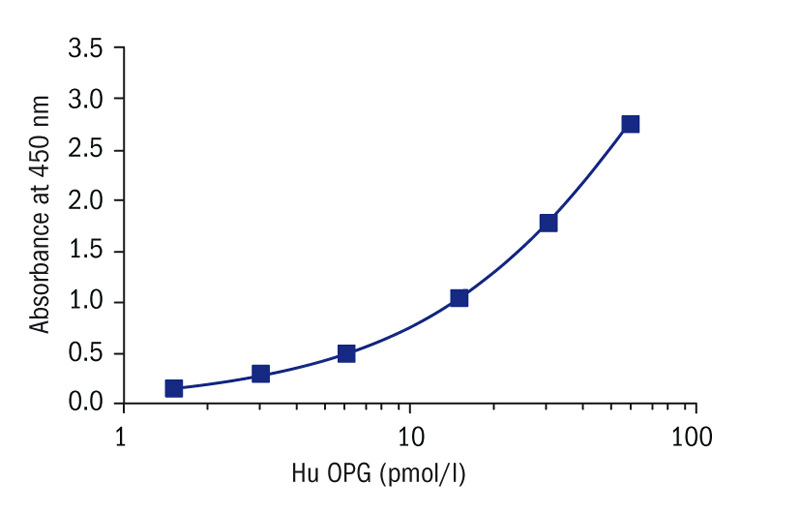
Calibration Curve

Calibration Range

1.5–60 pmol/l

Limit of Detection

0.03 pmol/l

Intra-assay (Within-Run)

n = 8; CV = 3.5%

Inter-assay (Run-to-Run)

n = 3; CV = 5.8%

Spiking Recovery

106,70%

Dilution Linearity

107,60%

Crossreactivity

  • bovine Non-detectable
  • cat Non-detectable
  • dog Non-detectable
  • goat Non-detectable
  • hamster Non-detectable
  • horse Non-detectable
  • mouse Non-detectable
  • pig Non-detectable
  • rabbit Non-detectable
  • rat Non-detectable
  • sheep Non-detectable
  • chicken Not tested
  • human Yes
  • monkey Yes (recommended dilution 1:3)

Note

The kits are CE-IVD certified and intended for professional use.

Summary

Features

  • European Union: for in vitro diagnostic use
  • Rest of the world: for research use only!
  • The total assay time is less than 3.5 hours
  • The kit measures osteoprotegerin in serum and plasma (EDTA, citrate, heparin)
  • Assay format is 96 wells
  • Quality Controls are human serum based
  • Standard is recombinant protein based
  • Components of the kit are provided ready to use, concentrated or lyophilized

Research topic

Bone and cartilage metabolism

Summary

Osteoprotegerin (OPG, osteoclastogenesis inhibitory factor, OCIF) is a product of
the TNFRSF11B gene, located on chromosome 8q24. OPG belongs to the TNF (tumor
necrosis factor receptor) superfamily, that plays a key role in bone remodeling. Human OPG
is a secreted glycoprotein composed of 401 aminoacid residues. OPG exists as a disulfidelinked
homodimer (120 kDa) or as a monomer (60 kDa). Both of these forms are active but
the dimer is more bioactive than the monomer. In contrast to most members of the TNF
receptor superfamily, OPG probably exists only in a soluble form. Its ligands are RANKL and
TRAIL. Human OPG shares 85% aminoacid identity to mouse OPG and 86 % identity to rat
OPG. In adult humans OPG mRNA is highly expressed in bones (osteblasts), endothelial
vessel cells, skin, liver, stomach, intestine, heart, brain and lung and is also present
in atherosclerotic plaques.

OPG and RANKL are involved in bone resorption and bone formation. OPG and receptor
RANK compete with each other for binding to the ligand RANKL. Binding of RANKL to RANK
stimulates osteoclasts and their activity. When RANKL binds to OPG, osteoclastogenesis
decreases. OPG prevents the formation of RANKL/RANK, inhibits formation of osteoclasts
and suppress bone resorption.

At normal physiological conditions OPG and ligand RANKL are in balance and bone resorption
and bone formation are linked. This balance can be disrupted by the lack of estrogens
in menopausal women, by anti-inflammatory effect of cytokines and by changes in the level
of glucocorticoids, thyroid hormones, parathyroid hormone or calcitriol. Any modification
in the RANKL/OPG ratio can induce either excessive bone resorption or, in contrast, excessive
bone formation. This disregulation can lead to pathological conditions such as
osteoporosis/osteopenia, bone tumor associated osteolysis, or cardiovascular pathology.
In postmenopausal osteoporosis, OPG serum level decreases and this decrease can be
an indicator of a higher risk for bones fracture. In patients with glucocorticoid induced
osteoporosis the RANKL/OPG ratio was higher. In patients with chronic obstructive pulmonary
disease with low bone mineral density (BMD), RANKL/OPG ratio was significantly higher
compared to those with normal BMD.

Patients with juvenile idiopathic arthritis had significantly lower levels of OPG in serum
and lower OPG/RANKL ratio.
The OPG/RANKL/RANK system affects the cardiovascular system as well. In patients with
ischemic heart disease the serum concentration of OPG was higher than that of healthy
people. In patients with high OPG the risk of cardiovascular mortality is three- or four-times
higher than it is in the healthy population.
Finally, the presence of malignant tumors leads to an inhibition of OPG production resulting
in high bone resorption.
The OPG/RANKL/RANK system affects bone loss in many pathological states and participates
in pathogenesis of vascular diseases. Determination of OPG concentration or RANKL/OPG
ratio is a clinical indicator in the diagnosis of the pathological states mentioned below.

Clinical use and areas of investigation:
Postmenopausal and glucocorticoid induced osteoporosis, Reumatoid arthritis, juvenile idiopathic arthritis, Ischemic heart disease, Diseases with changed bone resorption activity

Product References (76)

References

  • .
  • .
  • .
  • .
  • .
  • .
  • .
  • .
  • .
  • .
  • .
  • .
  • .
  • .
  • .
  • .
  • .
  • .
  • .
  • .
  • .
  • .
  • .
  • .
  • .
  • .
  • .
  • .
  • .
  • .
  • .
  • .
  • .
  • .
  • .
  • .
  • .
  • .
  • .
  • .
  • .
  • .
  • .
  • .
  • .
  • .
  • .
  • .
  • .
  • .
  • .
  • .
  • .
  • .
  • .
  • .
  • .
  • .
  • .
  • .
  • .
  • .
  • .
  • .
  • .
  • .
  • .
  • .
  • .
  • .
  • .
  • .
  • .
  • .
  • .
  • .
Summary References (17)

References to Osteoprotegerin

  • Asanuma YF, Shimada Y, Kouzu N, Yokota K, Nakajima K, Sato K, Akiyama Y, Isozaki M, Mikami AS, Kobayashi H, Mimura T. Serum osteoprotegerin concentration is associated with carotid atherosclerotic plaque in patients with rheumatoid arthritis. Mod Rheumatol. 2012 May 15;
  • Aubin JE, Bonnelye E. Osteoprotegerin and its ligand: A new paradigm for regulation of osteoclastogenesis and bone resorption. Medscape Womens Health. 2000 Mar;5 (2):5
  • Avignon A, Sultan A, Piot C, Mariano-Goulart D, Thuan Dit Dieudonne JF, Cristol JP, Dupuy AM. Osteoprotegerin: a novel independent marker for silent myocardial ischemia in asymptomatic diabetic patients. Diabetes Care. 2007 Nov;30 (11):2934-9
  • Bai P, Sun Y, Jin J, Hou J, Li R, Zhang Q, Wang Y. Disturbance of the OPG/RANK/RANKL pathway and systemic inflammation in COPD patients with emphysema and osteoporosis. Respir Res. 2011;12:157
  • Bucay N, Sarosi I, Dunstan CR, Morony S, Tarpley J, Capparelli C, Scully S, Tan HL, Xu W, Lacey DL, Boyle WJ, Simonet WS. osteoprotegerin-deficient mice develop early onset osteoporosis and arterial calcification. Genes Dev. 1998 May 1;12 (9):1260-8
  • Feuerherm AJ, Borset M, Seidel C, Sundan A, Leistad L, Ostensen M, Faxvaag A. Elevated levels of osteoprotegerin (OPG) and hepatocyte growth factor (HGF) in rheumatoid arthritis. Scand J Rheumatol. 2001;30 (4):229-34
  • Golledge J, McCann M, Mangan S, Lam A, Karan M. Osteoprotegerin and osteopontin are expressed at high concentrations within symptomatic carotid atherosclerosis. Stroke. 2004 Jul;35 (7):1636-41
  • Gurban CV, Mederle O. The OPG/RANKL system and zinc ions are promoters of bone remodeling by osteoblast proliferation in postmenopausal osteoporosis. Rom J Morphol Embryol. 2011;52 (3 Suppl):1113-9
  • Hofbauer LC. Osteoprotegerin ligand and osteoprotegerin: novel implications for osteoclast biology and bone metabolism. Eur J Endocrinol. 1999 Sep;141 (3):195-210
  • Kerschan-Schindl K, Mitterbauer M, Fureder W, Kudlacek S, Grampp S, Bieglmayer C, Fialka-Moser V, Pietschmann P, Kalhs P. Bone metabolism in patients more than five years after bone marrow transplantation. Bone Marrow Transplant. 2004 Sep;34 (6):491-6
  • Lien G, Ueland T, Godang K, Selvaag AM, Forre OT, Flato B. Serum levels of osteoprotegerin and receptor activator of nuclear factor -kappaB ligand in children with early juvenile idiopathic arthritis: a 2-year prospective controlled study. Pediatr Rheumatol Online J. 2010;8:30
  • Moran CS, McCann M, Karan M, Norman P, Ketheesan N, Golledge J. Association of osteoprotegerin with human abdominal aortic aneurysm progression. Circulation. 2005 Jun 14;111 (23):3119-25
  • Morse LR, Nguyen HP, Jain N, Williams S, Tun CG, Battaglino RA, Stashenko P, Garshick E. Age and motor score predict osteoprotegerin level in chronic spinal cord injury. J Musculoskelet Neuronal Inter. 2008 Jan-Mar;8 (1):50-7
  • Nellemann B, Gormsen LC, Dollerup J, Schmitz O, Mogensen CE, Rasmussen LM, Nielsen S. Simvastatin reduces plasma osteoprotegerin in type 2 diabetic patients with microalbuminuria. Diabetes Care. 2007 Dec;30 (12):3122-4
  • Roysland R, Bonaca MP, Omland T, Sabatine M, Murphy SA, Scirica BM, Bjerre M, Flyvbjerg A, Braunwald E, Morrow DA. Osteoprotegerin and cardiovascular mortality in patients with non-ST elevation acute coronary syndromes. Heart. 2012 May;98 (10):786-91
  • Secchiero P, Corallini F, Pandolfi A, Consoli A, Candido R, Fabris B, Celeghini C, Capitani S, Zauli G. An increased osteoprotegerin serum release characterizes the early onset of diabetes mellitus and may contribute to endothelial cell dysfunction. Am J Pathol. 2006 Dec;169 (6):2236-44
  • Simonet WS, Lacey DL, Dunstan CR, Kelley M, Chang MS, Luthy R, Nguyen HQ, Wooden S, Bennett L, Boone T, Shimamoto G, DeRose M, Elliott R, Colombero A, Tan HL, Trail G, Sullivan J, Davy E, Bucay N, Renshaw-Gegg L, Hughes TM, Hill D, Pattison W, Campbell P, Sander S, Van G, Tarpley J, Derby P, Lee R, Boyle WJ. Osteoprotegerin: a novel secreted protein i
Related Products Docs
Subscribe to Our Newsletter! Discover News from
BioVendor R&D
Subscribe Now
Subscribe to Our Newsletter! Discover News from
BioVendor R&D
Subscribe Now
zavřít