United States set
language
Menu Shopping cart $0 Search
Manufactured by BioVendor

Adipocyte FABP (FABP4) Human ELISA

Adipocyte FABP (FABP4) Human ELISA
  • Regulatory status:RUO
  • Type:Sandwich ELISA, Biotin-labelled antibody
  • Other names:Adipocyte-type fatty acid-binding protein, A-FABP, Fatty acid-binding protein 4, Adipocyte lipid-binding protein, ALBP, FABP4
  • Species:Human
United States orders are shipped from our US branch, BioVendor, LLC
Cat. No. Size Price


RD191036200R 96 wells (1 kit) $630
PubMed Product Details
Technical Data

Type

Sandwich ELISA, Biotin-labelled antibody

Applications

Serum, Plasma-EDTA, Plasma-Heparin, Plasma-Citrate

Sample Requirements

20 µl/well

Shipping

At ambient temperature. Upon receipt, store the product at the temperature recommended below.

Storage/Expiration

Store the kit at 2–8°C. Under these conditions, the kit is stable until the expiration date (see label on the box).

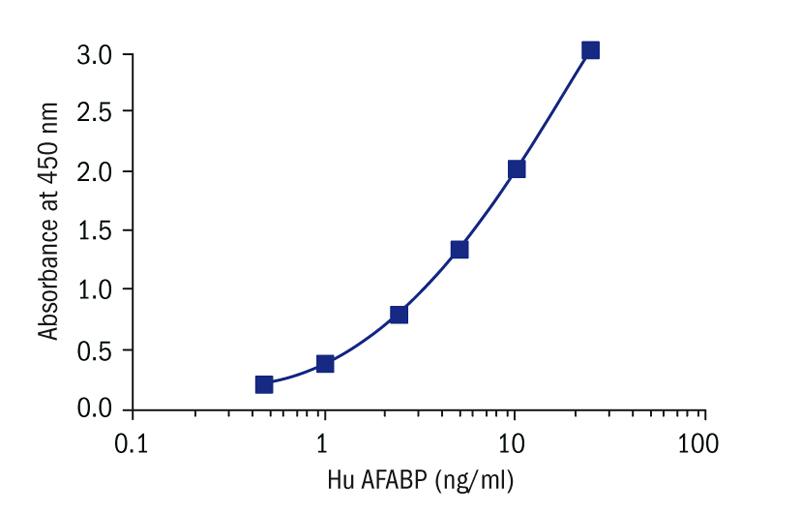
Calibration Curve

Calibration Range

0.5–25 ng/ml

Limit of Detection

0.05 ng/ml

Intra-assay (Within-Run)

n = 8; CV = 2.5%

Inter-assay (Run-to-Run)

n = 3; CV = 3.9%

Spiking Recovery

104,60%

Dilution Linearity

100,20%

Crossreactivity

  • bovine Non-detectable
  • cat None-specific binding
  • goat Non-detectable
  • hamster Non-detectable
  • horse Non-detectable
  • dog Yes (recommended dilution 1:3)
  • pig Non-detectable
  • rabbit Non-detectable
  • rat Non-detectable
  • sheep Non-detectable
  • chicken Not tested
  • human Yes
  • mouse Yes
  • monkey Yes (recommended dilution 1:3)

Note

The kits are CE-IVD certified and intended for professional use.

Summary

Features

  • It is intended for research use only
  • The total assay time is less than 4 hours
  • The kit measures total AFABP in serum and plasma (EDTA, citrate, heparin)
  • Assay format is 96 wells
  • Quality Controls are human serum based
  • Standard is recombinant protein based
  • Components of the kit are provided ready to use, concentrated or lyophilized
  • EU Patent Number: EP1904082

Research topic

Diabetology - Other Relevant Products, Energy metabolism and body weight regulation

Summary

Adipocyte fatty acid binding protein AFABP is a 15 kDa member of the intracellular fatty acid binding protein (FABP) family, which is known for the ability to bind fatty acids and related compounds (bile acids or retinoids) in an internal cavity. AFABP is expressed in a differentiation-dependent fashion in adipocytes and is a critical gene in the regulation of the biological function of these cells. In mice, targeted mutations in FABP4 (mouse gene is also called aP2 and its relevant protein P2 adipocyte protein or 3T3-L1 lipid binding protein) provide significant protection from hyperinsulinemia and insulin resistance in the context of both dietary and genetic obesity. Adipocytes obtained from AFABP-deficient mice also have reduced efficiency of lipolysis in vitro and in vivo, and these mice exhibited moderately improved systemic dyslipidemia. Recent studies also demonstrated AFABP expression in human macrophages upon differentiation and activation. In these cells, AFABP modulates inflammatory responses and cholesterol ester accumulation, and total or macrophage-specific AFABP deficiency confers dramatic protection against atherosclerosis in the apoE-/- mice. These results indicate a central role for AFABP in the development of major components of the metabolic syndrome through its distinct actions in adipocytes and macrophages.

Besides being active within the cell, AFABP appears to be a secreted protein (for normal levels and correlations with certain metabolic parameters see chapter 15). The extracellular role of secreted AFABP remains to be determined.

Product References (133)

References

  • .
  • .
  • .
  • .
  • .
  • .
  • .
  • .
  • .
  • .
  • .
  • .
  • .
  • .
  • .
  • .
  • .
  • .
  • .
  • .
  • .
  • .
  • .
  • .
  • .
  • .
  • .
  • .
  • .
  • .
  • .
  • .
  • .
  • .
  • .
  • .
  • .
  • .
  • .
  • .
  • .
  • .
  • .
  • .
  • .
  • .
  • .
  • .
  • .
  • .
  • .
  • .
  • .
  • .
  • .
  • .
  • .
  • .
  • .
  • .
  • .
  • .
  • .
  • .
  • .
  • .
  • .
  • .
  • .
  • .
  • .
  • .
  • .
  • .
  • .
  • .
  • .
  • .
  • .
  • .
  • .
  • .
  • .
  • .
  • .
  • .
  • .
  • .
  • .
  • .
  • .
  • .
  • .
  • .
  • .
  • .
  • .
  • .
  • .
  • .
  • .
  • .
  • .
  • .
  • .
  • .
  • .
  • .
  • .
  • .
  • .
  • .
  • .
  • .
  • .
  • .
  • .
  • .
  • .
  • .
  • .
  • .
  • .
  • .
  • .
  • .
  • .
  • .
  • .
  • .
  • .
  • .
  • .
Summary References (15)

References to Adipocyte Fatty Acid Binding Protein

  • Makowski L, Brittingham KC, Reynolds JM, Suttles J and Hotamisligil GS: The Fatty Acid-binding Protein, aP2, Coordinates Macrophage Cholesterol Trafficking and Inflammatory Activity. J Biol Chem. 2005 Apr 1.280(13):12888–95.
  • Maeda K, Cao H, Kono K, Gorgun CZ, Furuhashi M, Uysal KT, Cao Q, AtsumiG, Malone H, Krishnan B, Minokoshi Y, Kahn BB, Parker RA and Hotamisligil GS: Adipocyte/macrophage fatty acid binding proteins control integrated metabolic responses in obesity and diabetes. Cell Metabolism, Volume 1, Issue 2, February 2005, Pages 107–119.
  • Boord JB, Maeda K, Makowski L, Babaev VR, Fazio S, Linton MF, Hotamisligil GS: Combined adipocyte-macrophage fatty acid-binding protein deficiency improves metabolism, atherosclerosis, and survival in apolipoprotein E-deficient mice. Circulation. 2004 Sep 14;110(11):1492–8.
  • Lehmann F, Haile S, Axen E, Medina C, Uppenberg J, Svensson S, Lundback T, Rondahl L, Barf T: Discovery of inhibitors of human adipocyte fatty acid-binding protein, a potential type 2 diabetes target. Bioorg Med Chem Lett. 2004 Sep 6;14(17):4445–8.
  • Damcott CM, Moffett SP, Feingold E, Barmada MM, Marshall JA, Hamman RF, Ferrell RE: Genetic variation in fatty acid-binding protein-4 and peroxisome proliferatoractivated receptor gamma interactively influence insulin sensitivity and body composition in males. Metabolism. 2004 Mar;53(3):303–9.
  • Jenkins-Kruchten AE, Bennaars-Eiden A, Ross JR, Shen WJ, Kraemer FB, Bernlohr DA: Fatty acid-binding protein-hormone-sensitive lipase interaction. Fatty acid dependence on binding. J Biol Chem. 2003 Nov 28;278(48):47636–43.
  • Hertzel AV, Bennaars-Eiden A, Bernlohr DA: Increased lipolysis in transgenic animals overexpressing the epithelial fatty acid binding protein in adipose cells. J Lipid Res. 2002 Dec;43(12):2105–11.
  • Fu Y, Luo N, Lopes-Virella MF, Garvey WT: The adipocyte lipid binding protein (ALBP/aP2) gene facilitates foam cell formation in human THP-1 macrophages. Atherosclerosis. 2002 Dec;165(2):259–69.
  • Storch J, Veerkamp JH, Hsu KT: Similar mechanisms of fatty acid transfer from human anal rodent fatty acid-binding proteins to membranes: liver, intestine, heart muscle, and adipose tissue FABPs. Mol Cell Biochem. 2002 Oct;239(1–2):25–33.
  • Fisher RM, Hoffstedt J, Hotamisligil GS, Thorne A, Ryden M: Effects of obesity and weight loss on the expression of proteins involved in fatty acid metabolism in human adipose tissue. Int J Obes Relat Metab Disord. 2002 Oct;26(10):1379–85.
  • Boord JB, Maeda K, Makowski L, Babaev VR, Fazio S, Linton MF, Hotamisligil GS: Adipocyte fatty acid-binding protein, aP2, alters late atherosclerotic lesion formation in severe hypercholesterolemia. Arterioscler Thromb Vasc Biol. 2002 Oct 1;22(10):1686–91.
  • Fisher RM, Eriksson P, Hoffstedt J, Hotamisligil GS, Thorne A, Ryden M, Hamsten A, Arner P: Fatty acid binding protein expression in different adipose tissue depots from lean and obese individuals. Diabetologia. 2001 Oct;44(10):1268–73.
  • Scheja L, Makowski L, Uysal KT, Wiesbrock SM, Shimshek DR, Meyers DS, Morgan M, Parker RA, Hotamisligil GS: Altered insulin secretion associated with reduced lipolytic efficiency in aP2-/- mice. Diabetes. 1999 Oct;48(10):1987–94.
  • Coe NR, Simpson MA, Bernlohr DA: Targeted disruption of the adipocyte lipid-binding protein (aP2 protein) gene impairs fat cell lipolysis and increases cellular fatty acid levels. J Lipid Res. 1999 May;40(5):967–72.
  • Baxa CA, Sha RS, Buelt MK, Smith AJ, MatareseV, Chinander LL, Boundy KL and Bernlohr DA: Human adipocyte lipid-binding protein: purification of the protein and cloning of its complementary DNA. Biochemistry. 1989; 28 (22), 8683–8690.
Related Products Docs
Subscribe to Our Newsletter! Discover News from
BioVendor R&D
Subscribe Now
Subscribe to Our Newsletter! Discover News from
BioVendor R&D
Subscribe Now
zavřít