Type
Sandwich ELISA, Biotin-labelled antibody
Applications
Serum, Plasma-EDTA, Plasma-Heparin, Plasma-Citrate
Sample Requirements
6 ul/well
Shipping
At ambient temperature. Upon receipt, store the product at the temperature recommended below.
Storage/Expiration
Store the complete kit at 2–8°C. Under these conditions, the kit is stable until the expiration date (see label on the box).
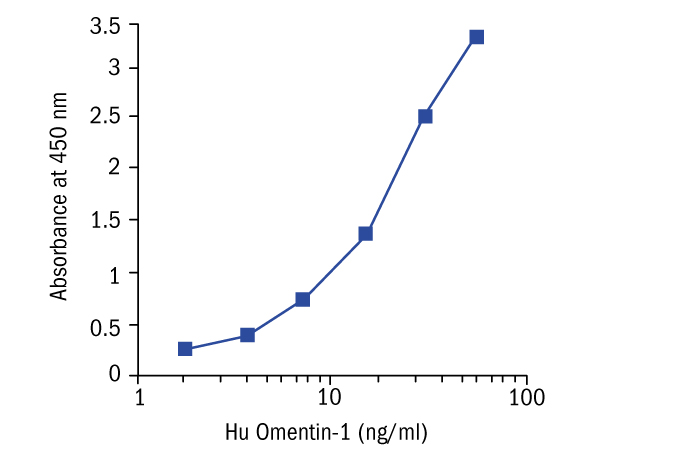
Calibration Curve
Calibration Range
2–64 ng/ml
Limit of Detection
0.5 ng/ml
Intra-assay (Within-Run)
n = 8; CV = 3.7%
Inter-assay (Run-to-Run)
n = 8; CV = 4.6%
Spiking Recovery
94,80%
Dilution Linearity
104,10%
Crossreactivity
- bovine Non-detectable
- cat Not tested
- dog Non-detectable
- goat Non-detectable
- hamster Non-detectable
- horse Not tested
- mouse Non-detectable
- pig Non-detectable
- rabbit Non-detectable
- rat Non-detectable
- sheep Non-detectable
- chicken Not tested
- human Yes
- monkey Strong reactivity (recom. dilution 1:80)
Note
More about Omentin-1 on BioVendor Scientific Blog
Features
- It is intended for research use only.
- The total assay time is less than 3.5 hours.
- The kit measures omentin-1 in serum and plasma (EDTA, citrate, heparin).
- Assay format is 96 wells.
- Quality Controls are human serum based. No animal sera are used.
- Standard is recombinant protein based.
- Components of the kit are provided ready to use, concentrated or lyophilized.
Research topic
Diabetology - Other Relevant Products, Energy metabolism and body weight regulation, Reproduction
Summary
Omentin (intelectin-1, intestinal lactoferin receptor, endothelian lectin HL-1, galactofuranosebinding lectin) is newly identified secretory protein that is highly and selectively expressed in visceral adipose tissue relative to subcutaneous adipose tissue (adipokine). The mature omentin is secretory glycoprotein consisting of 295 amino acids and 1-linked oligosacharides, and its basic structural unit is a 120-kDa homotrimer in which 40-kDa polipeptides are bridged by disulfide bonds. Omentin has been identified in other tissue at lower expression levels such are Paneth cells, endothelial cells, and visceral adipose stromal-vascular cells. A homolog of omentin has been identified that shares 83% amino acid identity with omentin and was referred to as omentin 2. The two omentin genes, omentin 1 and omentin 2, are localized adjacent to each other in chromosomal region, which has been previously linked to type 2 diabetes in several populations. To determine the impact of obesity-dependent insulin resistance on the regulation of two omentin isoforms, gene expression and plasma levels were measured in lean, overweight, and obese subjects. Omentin-1 was shown to be the major circulating isoform in human plasma. Lean subjects had significantly higher omentin-1 plasma levels than obese and overweight subjects. In addition, higher plasma omentin-1 levels were detected in women compared with men. Plasma omentin-1 levels were inversely correlated with BMI, waist circumference, leptin levels, and insulin resistance as measured by homeostasis model assessment and positively correlated with adiponectin and HDL levels. In summary, decreased omentin-1 levels are associated with increasing obesity and insulin resistance. An independent experiment reported that the addition of recombinant omentin-1 in vitro did not affect basal glucose uptake but did enhance insulin-stimulated glucose uptake in both subcutaneous and omental human adipocytes. Omentin-1 increased Akt phosphorylation in the absence and presence of insulin and may regulate insulin action. A recent study of women with the polycystic ovary syndrome (PCOS) found significantly reduced omentin-1 mRNA expression and protein levels in adipose tissue in overweight PCOS women. In addition, significantly lower plasma omentin-1 levels were detected in these women.
Find documents for the lot
Example Instructions for Use (RUO)
Example Instructions for Use (RUO)
Safety Information (RUO)
MSDS (RUO)
MSDS (RUO)