United States set
language
Menu Shopping cart $0 Search
Manufactured by BioVendor

Resistin Human ELISA

Resistin Human ELISA
  • Regulatory status:RUO
  • Type:Sandwich ELISA, Biotin-labelled antibody
  • Other names:Cysteine-rich secreted protein FIZZ3, Adipose tissue-specific secretory factor, ADSF, C/EBP-epsilon-regulated myeloid-specific secreted cysteine-rich protein, Cysteine-rich secreted protein A12-alpha-like 2, RETN, FIZZ3, HXCP1, RSTN, UNQ407/PRO1199
  • Species:Human
United States orders are shipped from our US branch, BioVendor, LLC
Cat. No. Size Price


RD191016100 96 wells (1 kit) $473
PubMed Product Details
Technical Data

Type

Sandwich ELISA, Biotin-labelled antibody

Applications

Serum, Plasma-EDTA, Plasma-Heparin, Plasma-Citrate

Sample Requirements

35 µl/well

Shipping

At ambient temperature. Upon receipt, store the product at the temperature recommended below.

Storage/Expiration

Store the kit at 2–8°C. Under these conditions, the kit is stable until the expiration date (see label on the box).

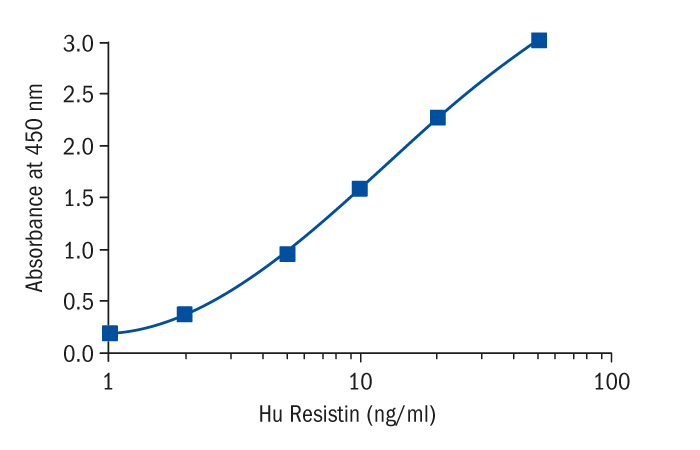
Calibration Curve

Calibration Range

1–50 ng/ml

Limit of Detection

0.012 ng/ml

Intra-assay (Within-Run)

n = 8; CV = 5.9%

Inter-assay (Run-to-Run)

n = 5; CV = 7.6%

Spiking Recovery

91,00%

Dilution Linearity

96,10%

Crossreactivity

  • bovine Non-detectable
  • cat Non-detectable
  • dog Non-detectable
  • goat Non-detectable
  • hamster Non-detectable
  • horse Yes (recommended dilution 1:6)
  • rabbit Non-detectable
  • rat Non-detectable
  • sheep Non-detectable
  • chicken Not tested
  • human Yes
  • monkey Yes (recommended dilution 1:3)
  • mouse Yes (recommended dilution 1:3)
  • pig Yes (recommended dilution 1:3)

Note

The kits are CE-IVD certified and intended for professional use.

More about Resistin on BioVendor Scientific Blog

Summary

Features

  • European Union: for in vitro diagnostic use
  • Rest of the world: for research use only!
  • The total assay time is less than 4 hours
  • The kit measures total resistin in serum and plasma (EDTA, citrate, heparin)
  • Assay format is 96 wells
  • Quality Controls are human serum based
  • Standard is recombinant protein based
  • Components of the kit are provided ready to use, concentrated or lyophilized

Research topic

Diabetology - Other Relevant Products, Energy metabolism and body weight regulation

Summary

Resistin, a product of the RSTN gene, is a peptide hormone belonging to the class of cysteinerich
secreted proteins which is termed the RELM family, and is also described as ADSF
(Adipose Tissue-Specific Secretory Factor) or FIZZ3 (Found in Inflammatory Zone). Human
resistin contains 108 amino acids as a prepeptide, and its hydrophobic signal peptide is
cleaved before its secretion. Resistin circulates in human blood as a dimeric protein consisting
of two 92 amino acid polypeptides, which are disulfide-linked via Cys26.

Much of the early investigations about the resistin molecule are based on the mouse model.
Resistin, produced and secreted primarily by adipocytes in mice, acts on skeletal muscle
myocytes, hepatocytes and adipocytes themselves so that it reduces their sensitivity to insulin.
Steppan et al. have suggested that resistin suppresses the ability of insulin to stimulate
glucose uptake. Other studies have shown that mouse resistin increases during the
differentiation of adipocytes, but it also seems to inhibit adipogenesis.

Compared to the mouse model, human adipogenic differentiation is likely to be associated with
a down regulation of resistin gene expression. On the other hand, resistin was found to be
expressed at high levels in human monocytes, macrophages and bone marrow.
Recent investigations have shown that human resistin is correlated with metabolic syndrome
and obesity-related disorders. Malo et al. have reported that resistin levels are positively
associated with waist circumference, tumor necrosis factor-a, and insulin resistance assessed
by the homeostasis model, and inversely correlated with total cholesterol, HDL cholesterol, and
LDL cholesterol. Moreover, Sadhasiv et al. found a positive correlation of SAT (subcutaneous
adipose tissue) resistin mRNA expression with serum resistin, BMI and insulin resistance
(HOMA index).

Based on the above reports human resistin might be an important marker that acts as the link
between obesity and insulin resistance. Resistin can play a role also in inflammation processes
and in atherosclerosis.
Clinical use and areas of investigation: Energy metabolism and body weight regulation, Metabolic syndrome, Inflammation, Atherosclerosis

Product References (213)

References

  • .
  • .
  • .
  • .
  • .
  • .
  • .
  • .
  • .
  • .
  • .
  • .
  • .
  • .
  • .
  • .
  • .
  • .
  • .
  • .
  • .
  • .
  • .
  • .
  • .
  • .
  • .
  • .
  • .
  • .
  • .
  • .
  • .
  • .
  • .
  • .
  • .
  • .
  • .
  • .
  • .
  • .
  • .
  • .
  • .
  • .
  • .
  • .
  • .
  • .
  • .
  • .
  • .
  • .
  • .
  • .
  • .
  • .
  • .
  • .
  • .
  • .
  • .
  • .
  • .
  • .
  • .
  • .
  • .
  • .
  • .
  • .
  • .
  • .
  • .
  • .
  • .
  • .
  • .
  • .
  • .
  • .
  • .
  • .
  • .
  • .
  • .
  • .
  • .
  • .
  • .
  • .
  • .
  • .
  • .
  • .
  • .
  • .
  • .
  • .
  • .
  • .
  • .
  • .
  • .
  • .
  • .
  • .
  • .
  • .
  • .
  • .
  • .
  • .
  • .
  • .
  • .
  • .
  • .
  • .
  • .
  • .
  • .
  • .
  • .
  • .
  • .
  • .
  • .
  • .
  • .
  • .
  • .
  • .
  • .
  • .
  • .
  • .
  • .
  • .
  • .
  • .
  • .
  • .
  • .
  • .
  • .
  • .
  • .
  • .
  • .
  • .
  • .
  • .
  • .
  • .
  • .
  • .
  • .
  • .
  • .
  • .
  • .
  • .
  • .
  • .
  • .
  • .
  • .
  • .
  • .
  • .
  • .
  • .
  • .
  • .
  • .
  • .
  • .
  • .
  • .
  • .
  • .
  • .
  • .
  • .
  • .
  • .
  • .
  • .
  • .
  • .
  • .
  • .
  • .
  • .
  • .
  • .
  • .
  • .
  • .
  • .
  • .
  • .
  • .
  • .
  • .
  • .
  • .
  • .
  • .
  • .
  • .
Summary References (21)

References to Resistin

  • Banerjee RR, Lazar MA. Dimerization of resistin and resistin-like molecules is determined by a single cysteine. J Biol Chem. 2001 Jul 13;276 (28):25970-3
  • Bokarewa M, Nagaev I, Dahlberg L, Smith U, Tarkowski A. Resistin, an adipokine with potent proinflammatory properties. J Immunol. 2005 May 1;174 (9):5789-95
  • Fasshauer M, Klein J, Neumann S, Eszlinger M, Paschke R. Tumor necrosis factor alpha is a negative regulator of resistin gene expression and secretion in 3T3-L1 adipocytes. Biochem Biophys Res Commun. 2001 Nov 9;288 (4):1027-31
  • Fasshauer M, Paschke R. Regulation of adipocytokines and insulin resistance. Diabetologia. 2003 Dec;46 (12):1594-603
  • Gong H, Ni Y, Guo X, Fei L, Pan X, Guo M, Chen R. Resistin promotes 3T3-L1 preadipocyte differentiation. Eur J Endocrinol. 2004 Jun;150 (6):885-92
  • Hartman HB, Hu X, Tyler KX, Dalal CK, Lazar MA:. Mechanisms Regulating Adipocyte Expression of Resistin. J Biol Chem. 277, 19754-19761, (2002) .
  • Juan CC, Au LC, Fang VS, Kang SF, Ko YH, Kuo SF, Hsu YP, Kwok CF, Ho LT. Suppressed gene expression of adipocyte resistin in an insulin-resistant rat model probably by elevated free fatty acids. Biochem Biophys Res Commun. 2001 Dec 21;289 (5):1328-33
  • Kershaw EE, Flier JS. Adipose tissue as an endocrine organ. J Clin Endocrinol Metab. 2004 Jun;89 (6):2548-56
  • Kim KH, Lee K, Moon YS, Sul HS. A cysteine-rich adipose tissue-specific secretory factor inhibits adipocyte differentiation. J Biol Chem. 2001 Apr 6;276 (14):11252-6
  • Maebuchi M, Machidori M, Urade R, Ogawa T, Moriyama T:. Low resistin levels in adipose tissues and serum high-fat fed mice and genetically obese mice: development of an ELISA system for quantification of resistin. Archiv Biochem Biophys. 416, 164-170 (2003) .
  • Malo E, Ukkola O, Jokela M, Moilanen L, Kahonen M, Nieminen MS, Salomaa V, Jula A, Kesaniemi YA. Resistin is an indicator of the metabolic syndrome according to five different definitions in the Finnish Health 2000 survey. Metab Syndr Relat Disord. 2011 Jun;9 (3):203-10
  • Meier U, Gressner AM. Endocrine regulation of energy metabolism: review of pathobiochemical and clinical chemical aspects of leptin, ghrelin, adiponectin, and resistin. Clin Chem. 2004 Sep;50 (9):1511-25
  • Milan G, Granzotto M, Scarda A, Calcagno A, Pagano C, Federspil G, Vettor R. Resistin and adiponectin expression in visceral fat of obese rats: effect of weight loss. Obes Res. 2002 Nov;10 (11):1095-103
  • Nogueiras R, Gallego R, Gualillo O, Caminos JE, Garcia-Caballero T, Casanueva FF, Dieguez C. Resistin is expressed in different rat tissues and is regulated in a tissue- and gender-specific manner. FEBS Lett. 2003 Jul 31;548 (1-3):21-7
  • Pravenec M, Kazdová L, Landa V, Zídek V, Mlejnek P, Jansa P, Wang J, Qi N, Kurtz TW:. Transgenic and recombinant resistin impair skeletal muscle glucose metabolism in the spontaneously hypertensive rat. J Biol Chem. 278, 45209-45215, (2001) .
  • Rajala MW, Obici S, Scherer PE, Rossetti L. Adipose-derived resistin and gut-derived resistin-like molecule-beta selectively impair insulin action on glucose production. J Clin Invest. 2003 Jan;111 (2):225-30
  • Sadashiv, Tiwari S, Paul BN, Kumar S, Chandra A, Dhananjai S, Negi MP. Over expression of resistin in adipose tissue of the obese induces insulin resistance. World J Diabetes. 2012 Jul 15;3 (7):135-41
  • Satoh H, Nguyen MT, Miles PD, Imamura T, Usui I, Olefsky JM. Adenovirus-mediated chronic "hyper-resistinemia" leads to in vivo insulin resistance in normal rats. J Clin Invest. 2004 Jul;114 (2):224-31
  • Steppan CM, Bailley ST, Brown EJ, Banerjee RR, Wright CM, Patel HR, Ahima RS, Lazar MA:. The Hormone Links Obesity to Diabetes. Nature. 409, 307-312, (2001) .
  • Steppan CM, Brown EJ, Wright CM, Bhat S, Banerjee RR, Dai CY, Enders GH, Silberg DG, Wen X, Wu GD, Lazar MA:. A Family of Tissue-specific Resistin-like Molecules. PNAS. 98, 502-506, (2001) .
  • Steppan CM, Lazar MA. The current biology of resistin. J Intern Med. 2004 Apr;255 (4):
Related Products Docs
Subscribe to Our Newsletter! Discover News from
BioVendor R&D
Subscribe Now
Subscribe to Our Newsletter! Discover News from
BioVendor R&D
Subscribe Now
zavřít