United States set
language
Menu Shopping cart $0 Search
Manufactured by BioVendor

S100B Human ELISA

S100B Human ELISA
  • Regulatory status:RUO
  • Type:Sandwich ELISA, Biotin-labelled antibody
  • Species:Human
United States orders are shipped from our US branch, BioVendor, LLC
Cat. No. Size Price


RD192090100R 96 wells (1 kit) $543
PubMed Product Details
Technical Data

Type

Sandwich ELISA, Biotin-labelled antibody

Applications

Serum, Cerebrospinal fluid

Sample Requirements

25 µl/well

Shipping

At ambient temperature. Upon receipt, store the product at the temperature recommended below.

Storage/Expiration

Store the complete kit at 2–8°C. Under these conditions, the kit is stable until the expiration date (see label on the box).

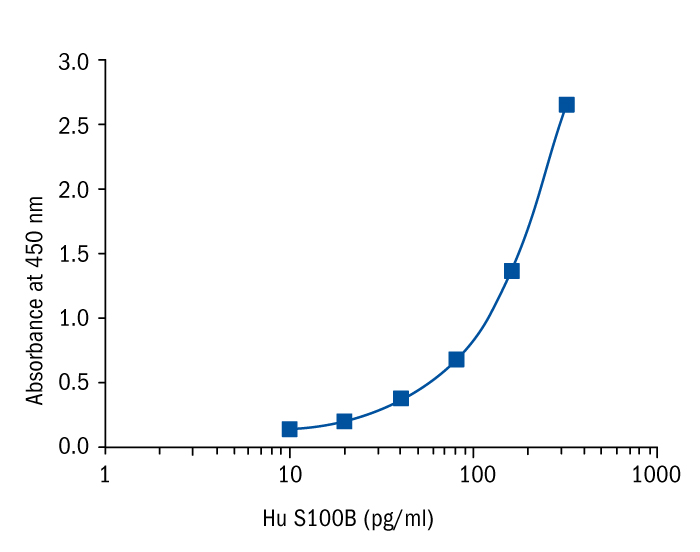
Calibration Curve

Calibration Range

10–320 pg/ml

Limit of Detection

The measurement range of the assay is 10 – 320 pg/ml (final concentration in a well after dilution).

Intra-assay (Within-Run)

n = 8; CV = 2.0 %

Inter-assay (Run-to-Run)

n = 4; CV = 5.9 %

Spiking Recovery

102.5 %

Dilution Linearity

111.6 %

Crossreactivity

  • bovine Yes
  • cat Yes
  • dog Non-detectable
  • horse Non-detectable
  • goat Yes
  • hamster Yes
  • mouse Non-detectable
  • pig Non-detectable
  • sheep Non-detectable
  • chicken Not tested
  • monkey Yes
  • human Yes
  • rabbit Yes
  • rat Yes
Summary

Features

  • It is intended for research use only
  • The total assay time is less than 5 hours
  • The kit measures S100B protein in serum and cerebrospinal fluid
  • Assay format is 96 wells
  • Quality Controls are human serum based. Animal serum is used for Master Standard and for Dilution Buffer preparation
  • Standard is native protein based
  • Components of the kit are provided ready to use, concentrated or lyophilized

Research topic

Neural tissue markers, Oncology

Summary

S-100B protein is a member of highly homologous acidic calcium and zinc binding proteins family (S100 family) that possess two EF-hand motifs. S100B is a bb homodimer with the molecular weight 21 kDa. S100B is abundant in the nervous system where it is predominantly expressed in astrocytes, oligodendrocytes and Schwann cells. S100B is released from brain tissue into cerebrospinal fluid (CSF) and blood following brain damage of different origin, i.e., brain infarction, intracerebral or subarachnoidal hemorrhage, neurotrauma and large intracerebral tumors. It is documented a relationship between degree of cell damage and S100B levels in CSF. Also patients with progressive melanoma disease show elevated serum concentrations of S100B.

Product References (49)

References

  • .
  • .
  • .
  • .
  • .
  • .
  • .
  • .
  • .
  • .
  • .
  • .
  • .
  • .
  • .
  • .
  • .
  • .
  • .
  • .
  • .
  • .
  • .
  • .
  • .
  • .
  • .
  • .
  • .
  • .
  • .
  • .
  • .
  • .
  • .
  • .
  • .
  • .
  • .
  • .
  • .
  • .
  • .
  • .
  • .
  • .
  • .
  • .
  • .
Summary References (15)

References to S100B

  • Zimmer, D.B, Cornwall, E.H., Landar, A. and Song, W.: The S100 Protein Family: History, Function, and Expression. Brain Research Bulletin. 37 (4), 417–429 (1995)
  • Kärnell R. et al: S100B Protein, 5-S-Cysteinyldopa and 6-Hydroxy-5-Methoxyindole-2-Carboxylic Acid as Biochemical Markers for Survival Prognosis in Patients with Malignant Melanoma. Melanoma Research 7, 393–399 (1997)
  • Jönsson H. et al: S100ı After Coronary Artery Surgery: Release Pattern, Source of Contamination, and Relation to Neuropsychological Outcome. Ann Thorac Surg. 68, 2202–2208 (1999)
  • Hauschild A. et al: S100B Protein Detection in Serum Is a Significant Prognostic Factor in Metastatic Melanoma. Oncology 56, 338–344 (1999)
  • Donato R: S100: a Multigenic Family of Calcium-Modulated Proteins of the EF-Hand Type with Intracellular and Extracellular Functional Roles. Int J Biochem Cell Biol. 33(7), 637–68 (2001)
  • Reynolds M.A. et al: Early Biomarkers of Stroke. Clinical Chemistry 49:10, 1733–1739 (2003)
  • Johnsson P et al: Increased S100B in Blood After Cardiac Surgery Is a Powerful Predictor of Late Mortality. Ann Thorac Surg 75, 162–168 (2003)
  • Beems T. et al: Serum- and CSF-concentrations of Brain Specific Proteins in Hydrocephalus. Acta Neurochir 145, 37–43 (2003)
  • Gazzolo D et al: S100B protein in urine of preterm newborns with ominous outcome. Pediatr Res. 2005 Dec;58(6):1170–4.
  • Fernandez-Fernandez MR et al: Proteins of the S100 family regulate the oligomerization of p53 tumor suppressor. Proc Natl Acad Sci USA. 2005 Mar 29; 102(13):4735–40.
  • Delgado P et al: Plasma S100B level after acute spontaneous intracerebral hemorrhage. Stroke. 2006 Nov;37(11):2837–9.
  • Ralay Ranaivo H et al: Glia as a therapeutic target: selective suppression of human amyloid-beta-induced upregulation of brain proinflammatory cytokine production attenuates neurodegeneration. J Neurosci. 2006 Jan 11;26(2):662–70.
  • Sanchez-Juan P et al: CSF tests in the differential diagnosis of Creutzfeldt-Jakob disease. Neurology. 2006 Aug 22;67(4):637–43.
  • Steiner J et al: Increased cerebrospinal fluid and serum levels of S100B in first-onset schizophrenia are not related to a degenerative release of glial fibrillar acidic protein, myelin basic protein and neurone-specific enolase from glia or neurones. J Neurol Neurosurg Psychiatry. 2006 Nov;77(11):1284–7.
  • Steiner J et al: Evidence for a wide extra-astrocytic distribution of S100B in human brain. BMC Neurosci. 2007 Jan 2;8:2.
Related Products Docs
Subscribe to Our Newsletter! Discover News from
BioVendor R&D
Subscribe Now
Subscribe to Our Newsletter! Discover News from
BioVendor R&D
Subscribe Now
zavřít