United States set
language
Menu Shopping cart $0 Search
Manufactured by BioVendor

Glial Fibrillary Acidic Protein Human ELISA (GFAP)

Glial Fibrillary Acidic Protein Human ELISA (GFAP)
  • Regulatory status:RUO
  • Type:Sandwich ELISA, Biotin-labelled antibody
  • Other names:GFAP
  • Species:Human
United States orders are shipped from our US branch, BioVendor, LLC
Cat. No. Size Price


RD192072200R 96 wells (1 kit) $711
PubMed Product Details
Technical Data

Type

Sandwich ELISA, Biotin-labelled antibody

Applications

Serum, Plasma-EDTA, Plasma-Heparin, Plasma-Citrate, Cerebrospinal fluid

Sample Requirements

35 µl/well

Shipping

At ambient temperature. Upon receipt, store the product at the temperature recommended below.

Storage/Expiration

Store the complete kit at 2–8°C. Under these conditions, the kit is stable until the expiration date (see label on the box).

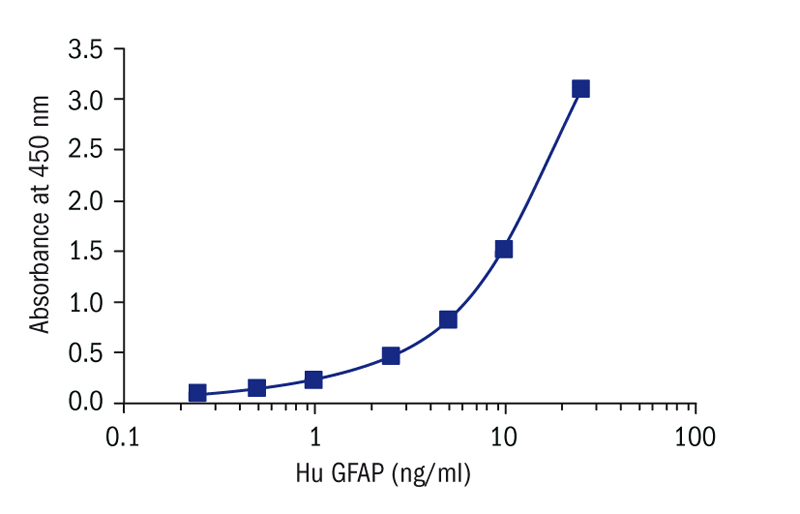
Calibration Curve

Calibration Range

0.25–25 ng/ml

Limit of Detection

0.045 ng/ml

Intra-assay (Within-Run)

n = 8; CV = 5.1%

Inter-assay (Run-to-Run)

n = 7; CV = 5.7%

Spiking Recovery

102,90%

Dilution Linearity

100,60%

Crossreactivity

  • bovine Not tested
  • cat Not tested
  • dog Not tested
  • goat Not tested
  • hamster Not tested
  • horse Not tested
  • human Not tested
  • chicken Not tested
  • monkey Not tested
  • mouse Not tested
  • pig Not tested
  • rabbit Not tested
  • rat Not tested
  • sheep Not tested
Summary

Features

  • It is intended for research use only
  • The total assay time is about 5 hours
  • The kit measures GFAP in serum, cerebrospinal fluid (CSF) and plasma
  • Assay format is 96 wells
  • Quality Controls are human serum based
  • Standard is purified native protein based
  • Components of the kit are provided ready to use, concentrated or lyophilized

Research topic

Neural tissue markers

Summary

Glial Fibrillary Acidic Protein (GFAP), as a member of the cytoskeletal protein family, is the principal 8-9 nm intermediate filament in mature astrocytes of the central nervous system (CNS). GFAP is a monomeric molecule with a molecular mass between 40 and 53 kDa and an isoelectric point between 5.7 and 5.8. GFAP is highly brain specific protein that is not found outside the CNS. Some studies showed that GFAP is released into the blood very soon after traumatic brain injury (TBI), that GFAP is related to brain injury severity and outcome after TBI and that GFAP is not released after multiple trauma without brain injury.

In the CNS following injury, either as a result of trauma, disease, genetic disorders, or chemical insult, astrocytes become reactive and respond in a typical manner, termed astrogliosis. Astrogliosis is characterized by rapid synthesis of GFAP. GFAP normally increases with age and there is a wide variation in collection and processing of human brain tissue. Thanks to the high brain specificity and early releasing from CNS after TBI, GFAP might be suitable marker for early diagnostics.

Areas of investigation: Brain injury, Ischemic stroke.

Product References (33)

References

  • .
  • .
  • .
  • .
  • .
  • .
  • .
  • .
  • .
  • .
  • .
  • .
  • .
  • .
  • .
  • .
  • .
  • .
  • .
  • .
  • .
  • .
  • .
  • .
  • .
  • .
  • .
  • .
  • .
  • .
  • .
  • .
  • .
Summary References (11)

References to Glial Fibrillary Acidic Protein

  • Runnerstam M et al.: Extracellular glial fibrillary acidic protein and amino acids in brain regions of patients with subarachnoid hemorrhage – correlation with level of consciousness and site of bleeding. Neurolofical Research. 19: 361–368 (1997)
  • Missler U et al.: Measurement of glial fibrillary acidic protein in human blood: analytical method and premiliary clinical results. Clinical Chemistry. 45(1): 138–41 (1999)
  • Eng LF et al.: Glial fibrillary acidic protein: GFAP – Thirty – One Years (1969–2000). Neurochemical Research. 25: 1439–1451 (2000)
  • Whitelaw A et al.: Brain specific proteins in postheamorrhagic ventricular dilatation. Arch Dis Child Fetal Neonatal Ed. 84: F90-F91 (2001)
  • Finch CE: Neurons, Glia, and Plasticity in normal Brain Aging. Adv Gerontol. 10: 35–39 (2002)
  • Beems T et al.: Serum- and CSF-concentrations of brain specific proteins in hydrocephalus. Acta Neurochirurgica. 145: 37–43 (2003)
  • Pelinka LE et al.: Glial fibrillary acidic protein in serum after traumatic brain injury and multiple trauma. Journal of Trauma. 57: 1006–1012 (2004)
  • Pelinka LE et al.: GFAP versus S100B in serum after traumatic brain injury: Relationship to brain damage and outcome. Journal of Neurotrauma. 21: 1553–1561 (2004)
  • Mouser PE et al.: Caspase-Mediated Cleavage of Glial Fibrillary Acidic Protein within Degenerating Astrocytes of the Alzheimer’s Disease Brain. Am J Pathol. 168(3): 936– 946 (2006)
  • Blechingberg J et al.: Regulatory mechanisms for 3'-end alternative splicing and polyadenylation of the Glial Fibrillary Acidic Protein, GFAP, transcript. Nucleic Acids Res. 35(22): 7636–50 (2007)
  • Brommeland T et al.: Serum levels of glial fibrillary acidic protein correlate to tumour volume of high-grade gliomas. Acta Neurol Scand. 116(6): 380–4 (2007)
Related Products Docs
Subscribe to Our Newsletter! Discover News from
BioVendor R&D
Subscribe Now
Subscribe to Our Newsletter! Discover News from
BioVendor R&D
Subscribe Now
zavřít