United States set
language
Menu Shopping cart $0 Search
Manufactured by BioVendor

Surfactant Protein D Human ELISA

Surfactant Protein D Human ELISA
  • Regulatory status:RUO
  • Type:Sandwich ELISA, Biotin-labelled antibody
  • Other names:SP-D
  • Species:Human
United States orders are shipped from our US branch, BioVendor, LLC
Cat. No. Size Price


RD194059101 96 wells (1 kit) $618
PubMed Product Details
Technical Data

Type

Sandwich ELISA, Biotin-labelled antibody

Applications

Serum, Plasma-EDTA, Plasma-Heparin, Plasma-Citrate, Bronchoalveolar lavage, Amniotic fluid

Sample Requirements

10 µl/well

Shipping

At ambient temperature. Upon receipt, store the product at the temperature recommended below.

Storage/Expiration

Store the complete kit at 2–8°C. Under these conditions, the kit is stable until the expiration date (see label on the box).

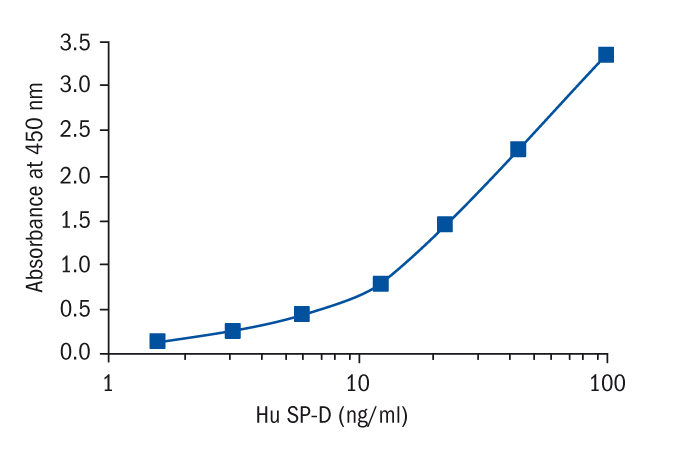
Calibration Curve

Calibration Range

1.56–100 ng/ml

Limit of Detection

0.01 ng/ml

Intra-assay (Within-Run)

n = 8; CV = 2.2%

Inter-assay (Run-to-Run)

n = 5; CV = 3.1%

Spiking Recovery

95,60%

Dilution Linearity

97,10%

Crossreactivity

  • bovine Yes
  • cat Non-detectable
  • dog Non-detectable
  • goat Non-detectable
  • hamster Non-detectable
  • horse Yes
  • mouse Non-detectable
  • pig Non-detectable
  • rabbit Non-detectable
  • rat Non-detectable
  • sheep Non-detectable
  • chicken Not tested
  • monkey Yes
  • human Yes

Note

The kits are CE-IVD certified and intended for professional use.

Summary

Features

  • European Union: for in vitro diagnostic use
  • Rest of the world: for research use only!
  • The total assay time is less than 5 hours
  • The kit measures total surfactant protein D in serum, plasma (EDTA, citrate, heparin), bronchoalveolar lavage fluid and amniotic fluid
  • Assay format is 96 wells
  • Quality Controls are human serum based. No animal sera are used
  • Standard is recombinant protein based
  • Components of the kit are provided ready to use, concentrated or lyophilized

Research topic

Immune Response, Infection and Inflammation, Pulmonary diseases, COVID-19

Summary

Human Surfactant Protein D (SP-D) is a member of the collageneous subfamily of
glycoproteins and calcium-dependent lectins (collectins).
SP-D is a homotrimeric protein consisting of three 43kDa units that are bonded at their Ntermini.
Most preparations of SP-D contain predominantly dodecamers (four trimeric subunits),
but also higher multimers have been observed. Each unit consists of at least four discrete
structural domains: a short N-terminal domain; a relatively long collagenous domain, a short
amphipathic connecting peptide, and a C-terminal, C- type lectin carbohydrate recognition
domain (CRD).

SP-D is synthesized and secreted by two types of non-ciliated epithelial cells in the peripheral
airway, alveolar type II cells and Clara cells. It is also expressed by various epithelial cells in
the gastrointestinal and genitourinary tracts and placenta.
In the lungs, SP-D participates in the innate response to inhaled microorganisms and organic
antigens. SP-D acts by aggregating bacteria and viruses, leukocyte function and stimulating an
allergenic response. SP-D binds to the surface glycoconjugates of various microorganisms (eg,
influenza virus, HIV, HSV, RSV, Mycoplasma pneumoniae) and the oligosaccharides
associated with the surface of numerous organic antigens and enhances their phagocytosis.
Studies have shown that SP-D binds to T cells, thus inhibiting their proliferation. SP-D also
binds with inflammatory ligands via protein-protein and protein-carbohydrate interactions that
are effective in reducing specific inflammation. In addition, SP-D binds to apoptotic cells and
stimulates their phagocytosis by macrophages governed by mechanisms dependent and CD91
calreticulin.

Given that SP-D together with SP-A affects the reactivity of immune cells, their presence in the
endometrium and placenta plays an important role in protection against bacteria and toxins
during pregnancy. Reduced levels of all components of pulmonary surfactant, including SP-D,
has been linked to premature birth.

Disturbance of pulmonary surfactant is in many cases the reason for collapse of the lungs and
is also associated with many pulmonary diseases. All types of chronic lung disease is
characterized by pathologically altered levels in lung tissue (fibrosis and emphysema). Studies
have shown that expression of SP-D is associated with many pulmonary diseases: cystic
fibrosis, acute interstitial pneumonia (ARDS), chronic obstructive pulmonary disease, asthma,
bronchopulmonary dysplasia, alveolar capillary dysplasia, alveolar proteinase and tuberculosis.
Clinical application and areas of investigation: Cystic fibrosis, Acute interstitial pneumonia (ARDS), Chronic obstructive pulmonary disease, Asthma, Bronchopulmonary dysplasia, Alveolar capillary dysplasia and alveolar proteinase, Immune response, infection and inflammation

Product References (80)

References

  • .
  • .
  • .
  • .
  • .
  • .
  • .
  • .
  • .
  • .
  • .
  • .
  • .
  • .
  • .
  • .
  • .
  • .
  • .
  • .
  • .
  • .
  • .
  • .
  • .
  • .
  • .
  • .
  • .
  • .
  • .
  • .
  • .
  • .
  • .
  • .
  • .
  • .
  • .
  • .
  • .
  • .
  • .
  • .
  • .
  • .
  • .
  • .
  • .
  • .
  • .
  • .
  • .
  • .
  • .
  • .
  • .
  • .
  • .
  • .
  • .
  • .
  • .
  • .
  • .
  • .
  • .
  • .
  • .
  • .
  • .
  • .
  • .
  • .
  • .
  • .
  • .
  • .
  • .
  • .
Summary References (9)

References to Surfactant Protein D

  • Crouch EC. Surfactant protein-D and pulmonary host defense. Respir Res. 2000;1 (2):93-108
  • Greene KE, Wright JR, Steinberg KP, Ruzinski JT, Caldwell E, Wong WB, Hull W, Whitsett JA, Akino T, Kuroki Y, Nagae H, Hudson LD, Martin TR. Serial changes in surfactant-associated proteins in lung and serum before and after onset of ARDS. Am J Respir Crit Care Med. 1999 Dec;160 (6):1843-50
  • Honda Y, Kuroki Y, Matsuura E, Nagae H, Takahashi H, Akino T, Abe S. Pulmonary surfactant protein D in sera and bronchoalveolar lavage fluids. Am J Respir Crit Care Med. 1995 Dec;152 (6 Pt 1):1860-6
  • Inoue T, Matsuura E, Nagata A, Ogasawara Y, Hattori A, Kuroki Y, Fujimoto S, Akino T. Enzyme-linked immunosorbent assay for human pulmonary surfactant protein D. J Immunol Methods. 1994 Aug 1;173 (2):157-64
  • Nagae H, Takahashi H, Kuroki Y, Honda Y, Nagata A, Ogasawara Y, Abe S, Akino T. Enzyme-linked immunosorbent assay using F(ab')2 fragment for the detection of human pulmonary surfactant protein D in sera. Clin Chim Acta. 1997 Oct 31;266 (2):157-71
  • Ohnishi H, Yokoyama A, Kondo K, Hamada H, Abe M, Nishimura K, Hiwada K, Kohno N. Comparative study of KL-6, surfactant protein-A, surfactant protein-D, and monocyte chemoattractant protein-1 as serum markers for interstitial lung diseases. Am J Respir Crit Care Med. 2002 Feb 1;165 (3):378-81
  • Takahashi H, Fujishima T, Koba H, Murakami S, Kurokawa K, Shibuya Y, Shiratori M, Kuroki Y, Abe S. Serum surfactant proteins A and D as prognostic factors in idiopathic pulmonary fibrosis and their relationship to disease extent. Am J Respir Crit Care Med. 2000 Sep;162 (3 Pt 1):1109-14
  • Takahashi H, Kuroki Y, Tanaka H, Saito T, Kurokawa K, Chiba H, Sagawa A, Nagae H, Abe S. Serum levels of surfactant proteins A and D are useful biomarkers for interstitial lung disease in patients with progressive systemic sclerosis. Am J Respir Crit Care Med. 2000 Jul;162 (1):258-63
  • Ciftci F, Sen E, Arkan G, Acar D, Saryal S. The relation between serum surfactant protein-d level and chronic obstructive pulmonary disease severity.Biomedical Research (2018) Volume 29, Issue 7
Related Products Docs
Subscribe to Our Newsletter! Discover News from
BioVendor R&D
Subscribe Now
Subscribe to Our Newsletter! Discover News from
BioVendor R&D
Subscribe Now
zavřít